
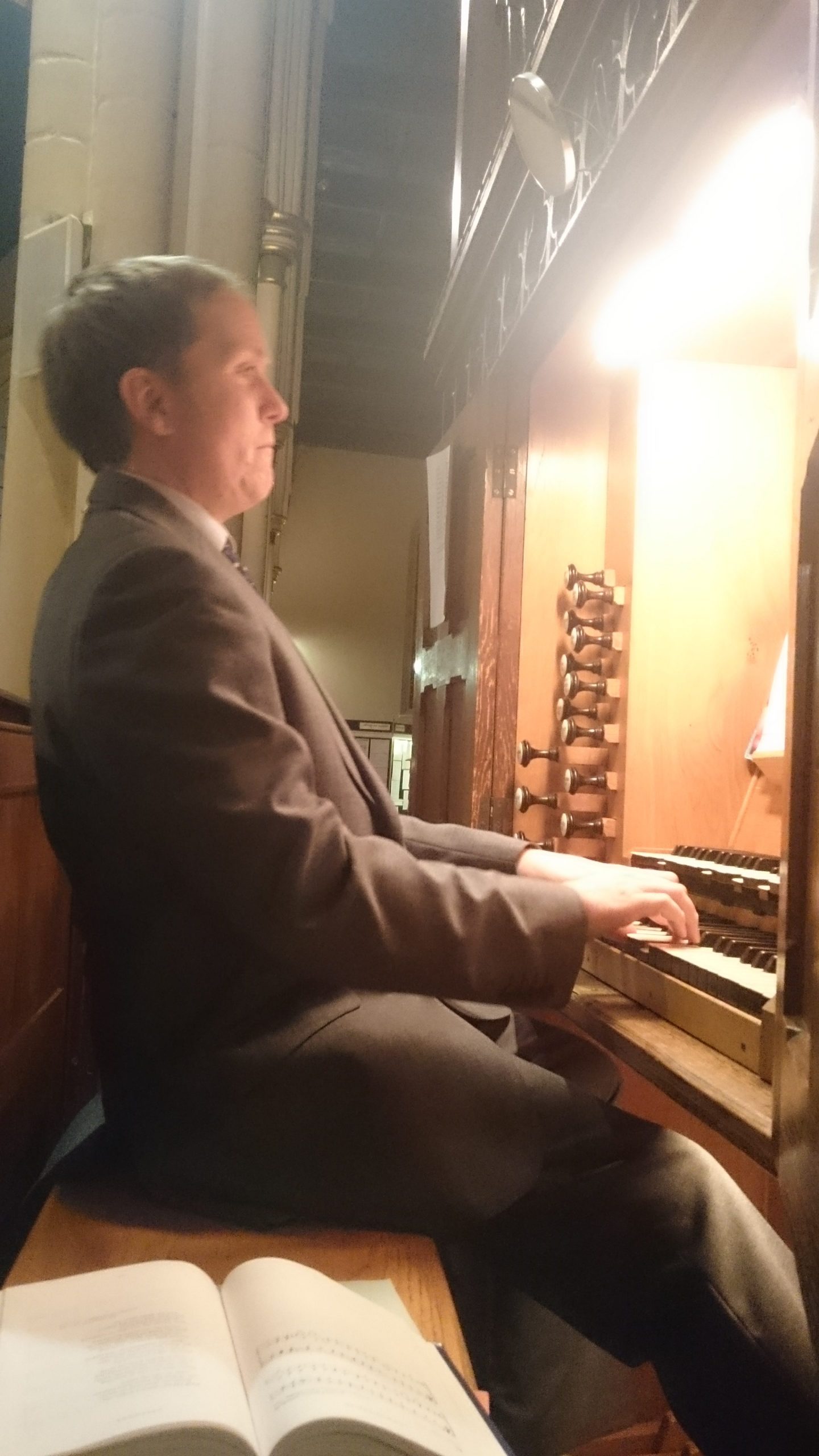
 The organ was installed in 1878, possibly the final part of Wyatt’s re-ordering. Previously the church boasted a small organ in a ‘gothick’ case (probably a single manual instrument) which was housed in the former west gallery and then, upon removal of the gallery, placed temporarily in the position of the present organ at the end of the north aisle. Galleries like this were a common feature of churches built before the mid-19th century and typically associated with the Evangelical emphasis on sermons and reading. It is no surprise, then, that Fr Holland removed it in the 1870s.
The external door to the staircase leading to the original organ still exists and can be spotted in the church’s brickwork. Records show that the former organ was donated to St John’s by the Revd James Devereux Hustler.
The present organ is by Hunter of Clapham. It cost £300 – which was raised in part by a series of concerts in the church – and was in many ways a typical two manual organ of the period. The original specification was unusual because the organ boasted two reed stops on the Great organ, plus a ‘Contra Salicional 16 foot stop’. The Swell department was conventional enough.
The organ has received a lot of attention throughout its life. The firms of Norman & Beard and Boggis of Diss have both worked on it, although perhaps the most curious of rebuilds was the one carried out by Stanton Gildersleeve of Bury St Edmunds. He was a local organ builder who traded from premises directly over the road from St. John’s Church.
At one time he was organist of Horringer Church. At an unknown date, possibly around the war years, Gildersleeve attempted to enlarge the Hunter organ to a three manual organ and a third manual was installed, plus provision was made inside the instrument for the addition of four stops. This would have been a ‘Solo division’, and it was somewhat ambitious for an organ of such modest size. It may be that money was never available for these pipes to be installed, so the third manual remained a dummy keyboard and the interior workings incomplete. At some point the original stopped diapason on the Great division was substituted with a ‘Claribel flute’ stop. This may have been Gildersleeve’s work.
In 1976 the organ was rebuilt and extensively altered by E J Johnson and Son of Cambridge. A new light-wood console and pedal board were installed with square shanked baroque-style stops. The original pedal pipes were destroyed and a new larger pedal division was installed. The original Hunter pipework was much altered and adapted to sound as different stops. The Swell organ was mostly altered and the Great organ was brightened up considerably. This work served the church well until about 2010 when the organ was completely rebuilt and restored, again by Johnson.
The original Hunter bellows were re-leathered and, at the instigation of the present organist and the then Diocesan organ advisor, the 1976 specification was respected, but tonal alterations were made in an attempt to restore the Victorian/English tone to the instrument. Three new stops were introduced and, as a result, the somewhat brash tone (fashionable in the 70s) has been removed.
As a result, St. John’s possesses a strikingly varied organ tonally. It is well capable of enriching the Anglo Catholic ceremonial style of worship and it can sound like a much larger instrument thanks to the bold stops installed in the 1970s. It is historically important as an example of an organ which has its origins in the Victorian era, but is tonally the work of the Classical organ movement of the 1970s – of how an instrument can evolve with the patterns of history and musical taste.