
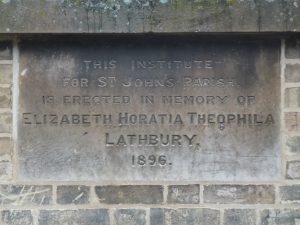
Miss Lathbury left a donation in her Will to St John’s, which was employed to establish The Lathbury Institute. It opened in 1896, and although ultimately converted into private dwellings, her name lives on in the name of the property, Lathbury Court.
Elizabeth Horatia Theophilia Lathbury (1817-93) was descended from an ancient Leicestershire family, the de Lathburys. She was the fourth of five daughters of the Revd Peter Lathbury LL.B (1761-1820) and his wife, Mary Anne Lathbury, née Mills (1780-1851). Mary had some success as an amateur painter while Peter was a noted botanist and naturalist, and sometime Rector of Great and Little Livermere. Elizabeth herself had a fine collection of local plants, made between the years 1832-59, which was frequently referred to in Dr Hind’s Suffolk Flora, considered the authoritative work for several decades. Her brother, the Revd Nathaniel Peter Edward Lathbury (1820-55), also made botanical records acknowledged by Hind. Elizabeth and her sisters were well-known for their musical abilities, often singing together at local events.
A resident of Angel Hill – she lived at no.6 with her sister Mary – Miss Lathbury was a generous benefactor in the town. She did not generally make her donations public, but one of the institutions which benefitted greatly from her philanthropy was Suffolk General Hospital. She was an active supporter of St James’s Church, to which she left £500 in her Will. The bequest of a similar amount to St John’s was employed to establish the Institute which bore her name, although she may not have had any direct connection with this church itself during her lifetime. The Lathbury Institute was opened in 1896, and although it was sold at the end of the following century and converted into private dwellings, her name lives on in the name of the property, Lathbury Court.
As well as making generous charitable donations, Miss Lathbury was also what we would now call a ‘social entrepreneur’. With her sisters she formed a Needlework Society, which assisted women of slender means by giving them work in their own homes. The scheme enabled the women to receive fair payment for their labour and to purchase garments at the cost of the materials only.