
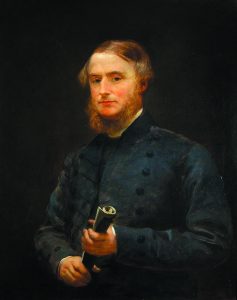
Henry Richard Graves Lord Arthur Hervey 1871, oil on canvas, Moyse’s Hall Museum, St Edmundsbury Heritage Service.
Lord Arthur Charles Hervey (1808-1894) was the fourth son of Frederick Hervey, 1st Marquess of Bristol, and the Marchioness, Elizabeth Albana Upton, daughter of Clotworthy Upton, 1st Baron Templetown. His paternal grandfather was Frederick Hervey, 4th Earl of Bristol and Bishop of Derry.
Born in London, Hervey was educated privately, then at Eton and Trinity College, Cambridge, where he obtained a first-class degree in the classical Tripos after a residence of two and a half years. He earned a Doctor of Divinity degree in 1869. Ordained both deacon and priest in October 1832, he was instituted in November to the small family living of Ickworth-cum-Chedburgh, Suffolk, with which he was associated until 1869. When, in 1844, Chedburgh was separated from Ickworth and joined to Horringer (still also known at the time by its earlier name, Horningsheath), he also became curate of Horringer.
Hervey took a leading role in the organisation of educational institutions in Bury St Edmunds, and may have been the first to propose a system of university extension. Now known variously as ‘continuing education’, ‘higher adult education’, ‘university adult education’ and ‘extramural studies’, this involves the provision of higher learning for people, usually adults, who are generally not full-time students. It was introduced at Cambridge in the mid-1860s.
In 1862 Hervey was appointed archdeacon of Sudbury, and in 1869, on the resignation of the Bishop of Bath and Wells, Lord Auckland, he was offered the bishopric on the recommendation of Prime Minister Gladstone. He remained in the post until his death in 1894, being usually known by his aristocratic courtesy title ‘Lord’ rather than the style appropriate to a bishop, the Right Reverend.
In churchmanship Hervey was considered a moderate evangelical. A competent linguist, he was one of the committee of revisers of the Authorised Version of the Old Testament, which sat from 1870-1884. In 1885 he received the honorary degree of Doctor of Divinity from the University of Oxford in recognition of his services. He contributed to William Smith’s Dictionary of the Bible and to the Speaker’s Commentary. Besides sermons, lectures and pamphlets, he was author of The Genealogies of our Lord and Saviour Jesus Christ reconciled (1853), Inspiration of Holy Scripture, (2nd ed 1889), Lectures on the Authenticity of the Gospel of St Luke and The Books of Chronicles in relation to the Pentateuch (1892).
Hervey married Patience Singleton, daughter of John Singleton (born Fowke), of Hacely, Hampshire, and Mell, County Louth, in 1839. They had twelve children, of whom five sons and three daughters survived him. He died near Basingstoke in his eighty-sixth year and is buried in Wells Cathedral.
In the 1870s, one of Hervey’s daughters trained the mute swans in the five-sided moat at the Bishops Palace to ring bells, by pulling strings, to request food.