
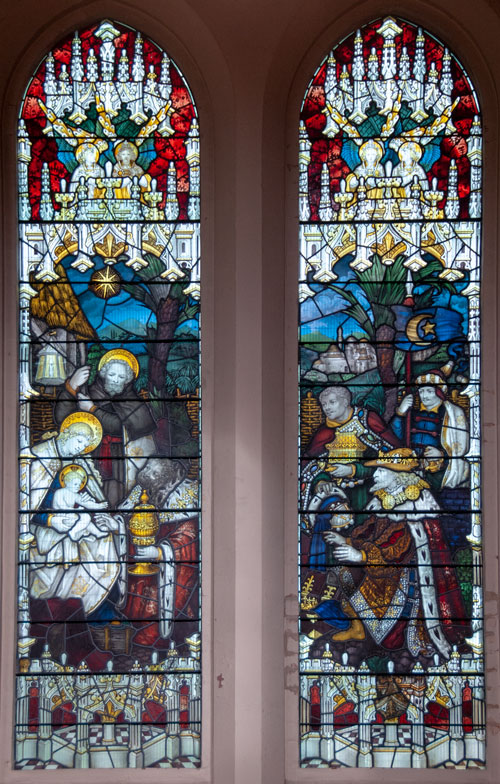
Lt. Col. Arthur John Watson (1853-1900) is remembered at St John’s by a window in the north aisle.
Lt. Col. Arthur John Watson (1853-1900) had a distinguished military career. Having joined the Army in August 1873, he was promoted to captain in April 1883, to major in October 1886 and to lieutenant colonel in September 1898. He served with the Bechuanaland Expedition of 1884-5 under Sir Charles Warren, and was mentioned in despatches, and took part in the Hazara Expedition in 1888 as brigade-major to the First Column, under Brigadier-General Channer. Again he was mentioned in despatches, and received the medal with clasp. He was Deputy Assistant Adjutant General in Bengal from 1889 to 1896, and later served with the Chitral Relief Force under Sir Robert Low, in 1897, as road commandant on the lines of communications, receiving the medal with clasp.
He obtained command of the 1st Battalion, Suffolk Regiment in September 1898 and took the battalion to South Africa in November 1899. On and around 6th January 1900 the Suffolks were at Colesburg and ordered to occupy a hill at Rensburg. They advanced up the hill in darkness and the Boers were entrenched at the top. The Boers were apparently well-informed of the attack, waited for them to get within yards, and then opened up with accurate rifle fire. Watson was killed early in the fight. A monument has been erected at Suffolk Hill, Colesberg in memory of all those who fell in this engagement. Watson’s entry reads, ‘Sacred to the memory of Lieut. Col. Arthur John Watson Commanding 1st Batt. The Suffolk Reg… Killed in Action near this spot 6 January 1900. Faithful unto Death.’
Watson was the son of William Watson (1804-83), a noted civil engineer who once considered taking Holy Orders, and his wife Sarah, née Morgan, whose father and brother were senior churchmen in Ireland. The Watson’s family home was 25 Fitzwilliam Place on Dublin’s famous Georgian Mile. Arthur had two sisters and three brothers, one of whom was Colonel Sir Charles Watson (1844-1916), who served under General Gordon in the Sudan and Lord Kitchener in Egypt. Arthur married Fairlie Caroline Gordon Anderson (1859-1934) and they had three daughters.
He is remembered at St John’s by a window in the north aisle (pictured).