
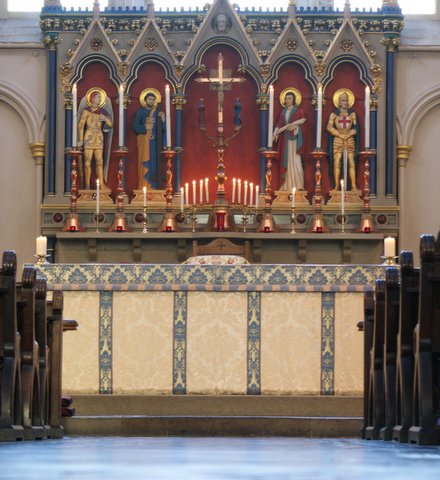
The reredos or altarpiece forms a backdrop to the altar and so to the most holy part of the church service: the Eucharist, when bread and wine, as the Body and Blood of Jesus, are shared among the congregation.
This reredos was donated as part of the major refurbishments of the church carried out under Revd Stewart Holland. It is made of alabaster and Cornish and Irish marble, and was designed by J. Drayton Wyatt, the diocesan architect, who oversaw the renovations of the 1870s. It was an important addition to the building as the church was being refurbished to emphasise the sacred significance of the east end of the church, the chancel, for the newly ritualised services of that period. In 1876, the local newspaper reported that:
the one defect of the church is, undoubtedly, the want of a larger chancel, and this cannot well be removed; but as the next best thing a new reredos has been given by an anonymous donor, which very greatly improves the appearance of the east end of the church.
Originally, the reredos was unpainted, coloured only by the natural colour of the stone. The centre panel contained a marble cross, and the niches to either side had stone medallions carved with the Alpha and Omega, the Chi Rho and the IHS. These are all ‘sacred monograms’, letters with special significance in Christianity. Alpha and Omega are the first and last letters of the Greek alphabet; they are used to describe Christ in the Book of Revelation, the last book of the Bible, traditionally thought to be written by St John, and indicate the eternity of Jesus. The Chi Rho are the first two Greek letters of ‘Christos’ and, when combined, form one of the oldest symbols of Christianity. They look like an English ‘X’ and ‘P’. IHS is made up of the first three Greek letters of Jesus, and it represents another ancient way of referring to God.
 In 1947, the reredos was painted and four wooden sculptures were installed. From left to right, they are St Michael, St Peter, St John and St George. The saints have been chosen as two pairs around the centre of the reredos. St John, of course, is the dedication saint of the church and St Peter is considered to be the first Pope and a symbol of the institutional Church; while St George is the patron saint of England and the archangel St Michael is another famous warrior saint. Each has a symbol in the roundel beneath his feet that indicates his identity: that of St John, for example, shows the poisoned chalice that, according to tradition, he was challenged to drink by the high priest of Diana at Ephesus. To right and left are two musicians, symbolising the celebratory spirit of the Mass. In the centre is the face of God the Father, designed to be seen above an altar cross showing the Crucifixion. It is designed in a rather free late-medieval Gothic style. The reredos was painted gold and silver in the 1960s and restored to its earlier, 1947, colouring by Helen McIldowie-Daltrey in 1996.
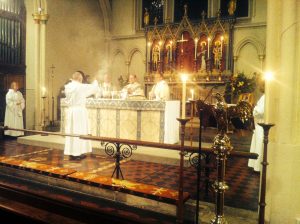
Originally, the altar was directly below this reredos and against the wall because the priest faced east, away from the congregation, during the service. Today, the priest faces the congregation to the west as part of reforms carried out in church liturgy in the later 20th century. You can still see the edge of the original altarpiece to the left-hand side of the reredos.