
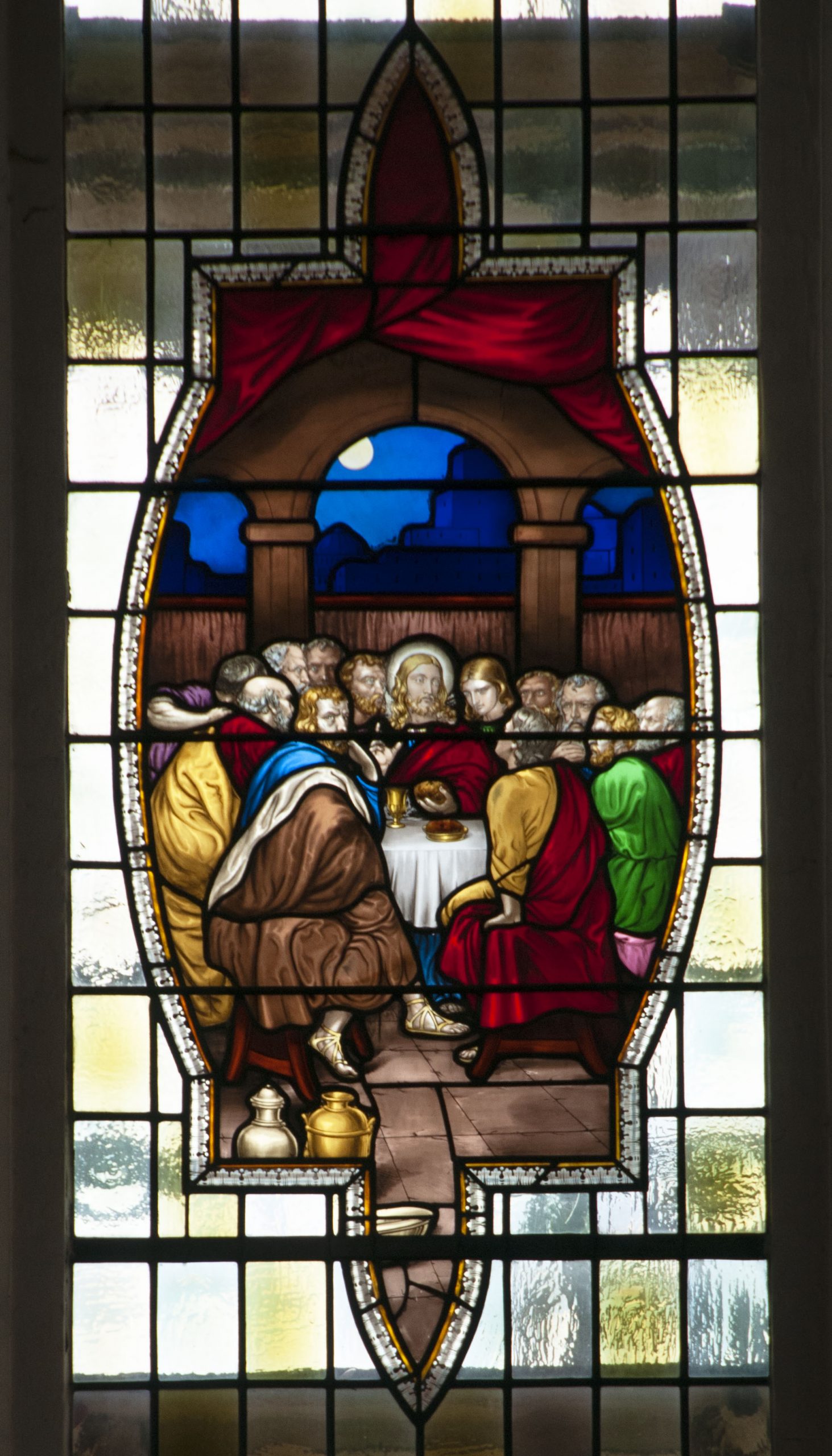
 The three lancets of the east window show three significant episodes from the life of Christ as recorded in the Gospels: from left to right, the Last Supper, the Crucifixion and the Ascension.
The Last Supper scene shows the moment at which Christ institutes the Eucharist, the blessing of bread and wine, with his disciples. This is usually assumed to have taken place on the night before the Crucifixion, although the Gospels do not explicitly say so. Jesus describes the bread as ‘my body, given for you; do this in remembrance of me’, and the cup as ‘the new covenant in my blood, which is poured out for you’ (Luke 22:19-20). Christ holds a loaf of bread in his left hand and blesses it with his right. This moment is commemorated weekly on the altar that now sits below this window.
From our viewpoint, to Christ’s right sits the beardless St John, called the ‘Beloved Disciple’, and, of course, of special importance to this church. At the front and to the left, sits Judas, wearing blue and brown, who is the only disciple to look not at Christ but at us, away from the window scene. He will shortly betray Christ for money, leading to Christ’s death on the cross. At the front of the scene is the basin where Christ has washed the disciples’ feet.
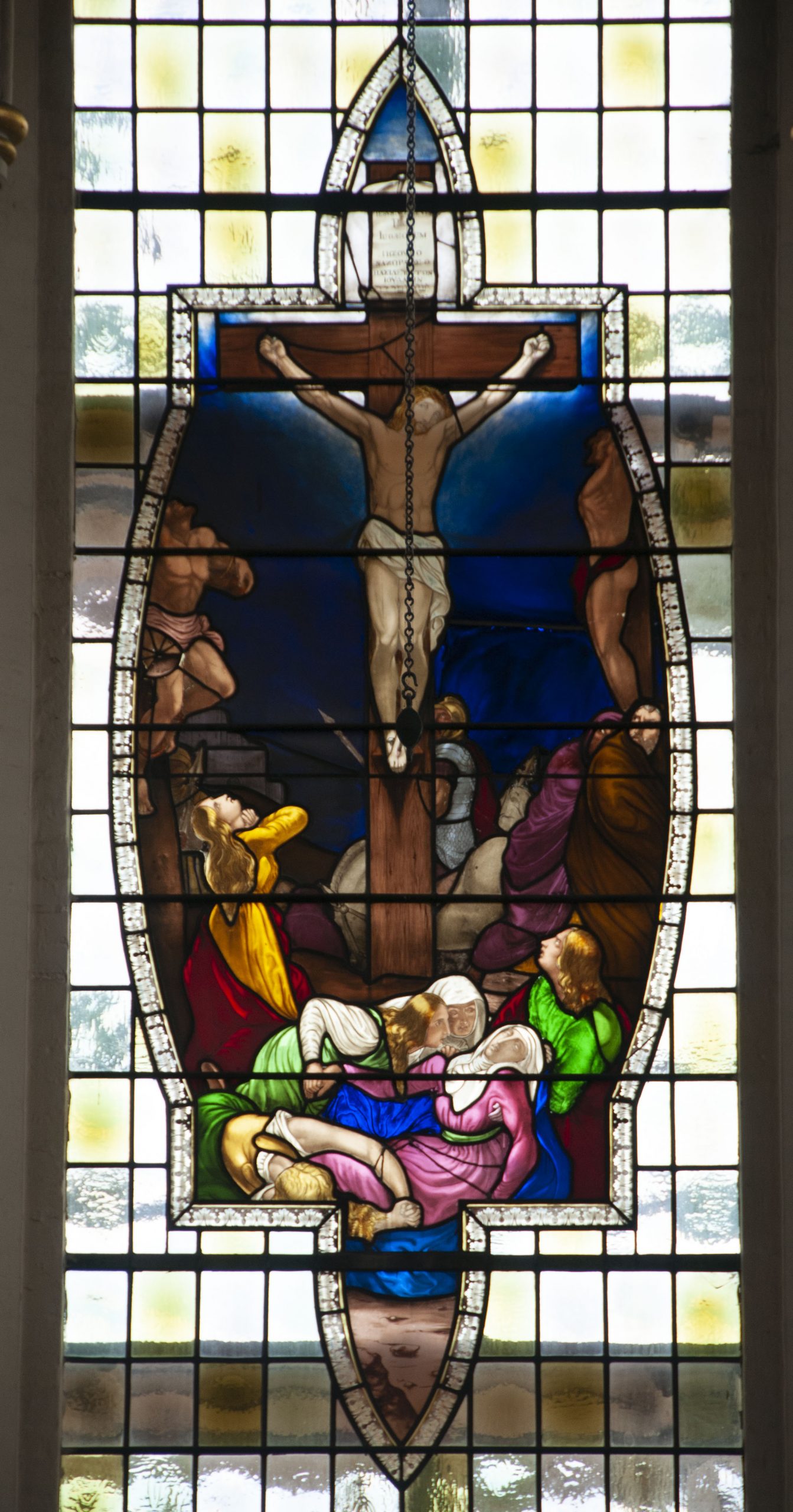 In the centre the Crucifixion of Christ is depicted. This is a scene often represented over the altar, where the death of Christ is commemorated in the Eucharist by the distribution of bread and wine – which, depending on belief, become or represent the body and blood of Jesus.
The window shows Christ, dead on the cross and flanked by the Good Thief (to his right, looking upwards towards Christ) and the Bad Thief (to his left, looking downwards, towards us). Below him to the left is Mary Magdalene in yellow, who stayed faithful to the last; St John, in green; and the Virgin Mary, his mother, in pink, who has fainted from grief and is being supported by the other Marys.
Behind the cross rides the centurion who has pierced Christ’s side with his spear while he was hanging on the cross. Above Christ’s head, is displayed in Latin, the phrase, ‘Jesus of Nazareth, King of the Jews’. John’s Gospel records this as being written in Hebrew, Latin and Greek.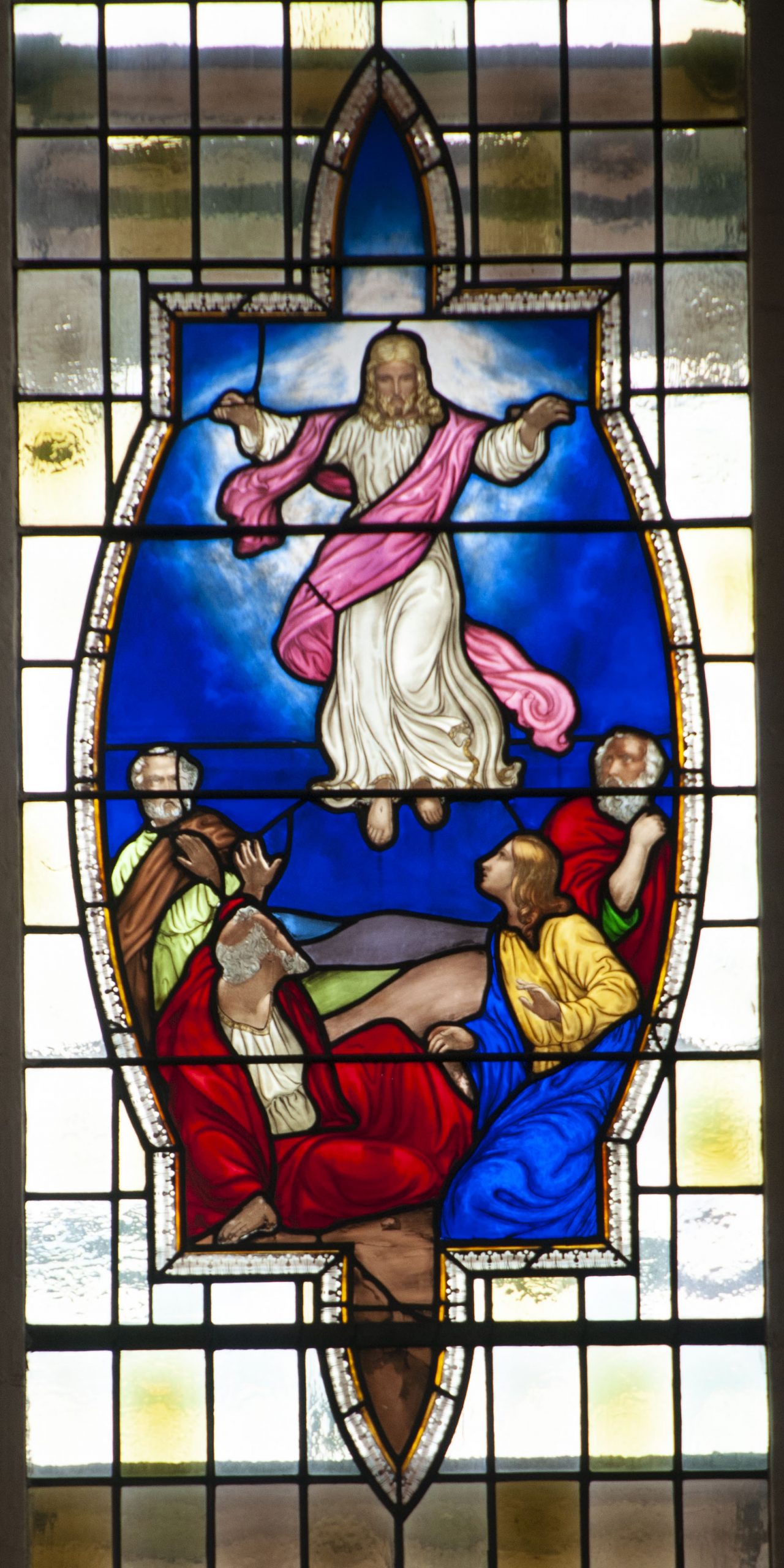
The Ascension scene shows the moment that Christ ascended into heaven, described as taking place in Bethany, a village on the Mount of Olives, in St Luke’s Gospel and the Book of Acts, by the same author. Christ, with his pierced feet clearly visible, is rising into heaven while four of the disciples look bewildered below. Most prominent among them is, of course, St John.
These images were reset in 1960, replacing the pattern of yellow glass that was originally installed. The Crucifixion was given by Thomas Anderson in memory of his mother Catherine, who died in 1856, and the other two by public subscription. All three windows were made by Forrest and Bromley of Liverpool. They were described as ‘peculiar’ by Tymms’ 1872 guide to Bury St Edmunds.