
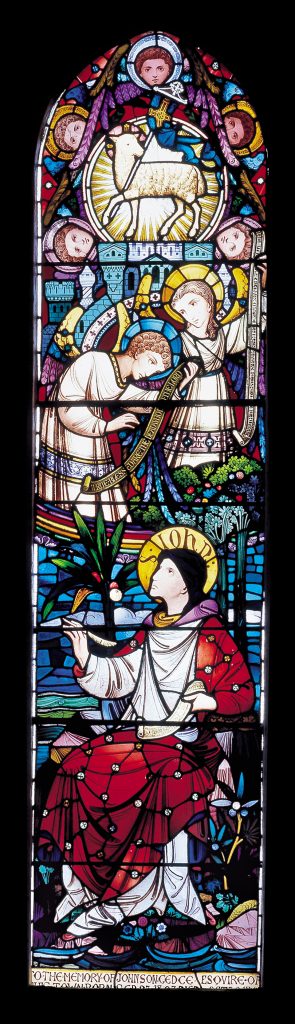
The Gedge memorial window.
In this window, St John of Patmos is writing the final book of the Bible, the Book of Revelation, on the Greek Island of Patmos.
There are three important ‘St Johns’ in the Bible: St John the Apostle, Jesus’ Beloved Disciple; St John the Evangelist, author of the Gospel of St John; and St John of Patmos. However, the three are traditionally combined. St John, his name written in his halo, is shown in the act of writing, while interrupted by a vision of two angels, who hold a scroll showing the words of Revelation 14:13: ‘And I heard a voice from heaven saying unto me, Write, Blessed are the dead which die in the Lord’.
The window commemorates Johnson Gedge, the editor of the Bury & Norwich Post for forty years, who died in 1863. His father, Peter, had helped establish the paper in 1782 and had been its editor. Gedge was also involved in the founding of St John’s in 1841 and the family remained prominent members of the community for the rest of the century.
This window was designed by Heaton, Butler and Bayne in Covent Garden, London. They were one of the leading manufacturers of Gothic Revival stained glass in England, with commissions from leading architects and churches, including Westminster Abbey. The business was founded by Clement Heaton (1824-82) and James Butler (1830-1913) in 1855, changing its name in 1862 when one of their younger assistants, Robert Turnill Bayne (1837-1915), was made a partner.
Bayne became the company’s sole designer, and experts note the ‘clear hand of Bayne’ in this particular window. Heaton, Butler and Bayne were the third largest suppliers of windows to Suffolk churches in the nineteenth century.