
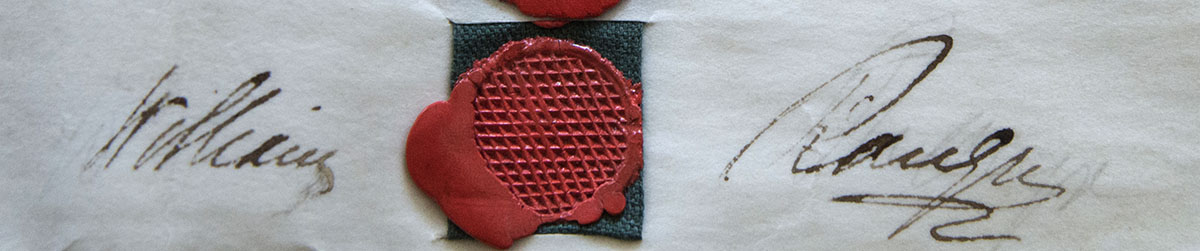
 It took just one year for the architect, William Ranger, to build St John’s church in 1841. Although it was made almost entirely of bricks, Ranger, a brilliant engineer, would also incorporate the latest building technologies to make slender cast iron pillars for his church. It was the first new church in Bury St Edmunds since the Middle Ages and was built to provide space for the town’s fast-growing population of labourers in the brewing and malting industries.
It was paid for by public subscription, although led by the Marquess of Bristol, Frederick Hervey, one of the most powerful men in the town, and cost £6,000 in total. Until 1870, it had just one vicar, Robert Rashdall, who oversaw a congregation that, although big by modern standards, was perhaps not as large as its first founders had hoped.
Show More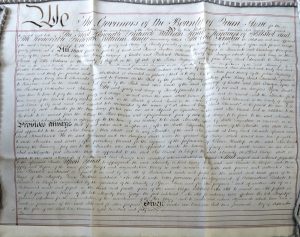
Deed of Consent from the Queen, (courtesy of The Suffolk Records Office in Bury St Edmunds).
St John’s was consecrated on 21 October 1841, in the middle of a period of radical change in Bury St Edmunds. The growth of the town’s brewing and malting industries had attracted thousands of newcomers looking for work. Since the start of the century, the population had risen by half to 11,000 or more. Nevertheless, the town still had only its two adjacent medieval churches, St James and St Mary, which together could seat fewer than 4,000, and even that number is exaggerated. Because many pews were private ones, owned by families or individuals, the number who could actually find a seat on a Sunday was considerably smaller.
In 1867 it was reported that, at St Mary’s, only 500 of its 2,000 seats were free. Competition for pews was so intense that some complained that parishioners had to campaign for them as they would in an election. Both churches were also at the eastern edge of the town, too far from the cottages being built at the north of the town.
Flushed with a growing economy and population, the town was expanding in other ways too: the previous thirty years had witnessed large amounts of civic construction, including the assembly rooms (1804), a theatre (1819), a refurbished corn exchange (1820), botanic gardens (1821, 1831) and a hospital (1825). Many other, non-Anglican, places of worship were being founded at almost the exactly the same time. These included the Baptist Church (built 1834), the Roman Catholic Church (1837) and the Methodist Church (1840).
The Anglican authorities feared not only that the new industrial workers would not go to church at all but that they would seek their religion elsewhere. Indeed, by 1851, a third of the town were not regularly attending any church or chapel, and a quarter were going to ‘dissenting’ places of worship: the Baptist, Congregational, Unitarian or Methodist chapels, or the Quakers’ (Friends) Meeting House. The local establishment hoped that if a new space for Anglican worshippers were made, somewhere close to the new growth in the town, they would find many willing newcomers.
By the late 1830s, the need for a new parish church in Bury St Edmunds had been recognised for a decade or more. In the late 1820s, it had even been proposed that the upper floor of the Market Cross could be converted for worship. By 1839, planning had begun in earnest to build a new church for the ‘accommodation of the poor’. The new terraced streets of Bury St Edmunds, many of which still exist today, were increasingly to the north of the town in an area called ‘Long Brackland’. The significance of this end of the town was underlined when the railway station was built here in 1846.
The building of the church was led by important people from the local church hierarchy and aristocracy. Of these, the most important by far was Frederick Hervey, 1st Marquess of Bristol. The Herveys were one of Bury’s two dominant families: a number of the Marquess’ ancestors had served as Member of Parliament for the town, and Frederick had studied at St John’s College, Cambridge, the new church’s dedication saint. The decision was made at a meeting of the Lecturers of St James in April 1839, and a site was found, with some difficulty, during the summer of 1839. (‘Lecturers’ or ‘Preachers’ were paid principally to deliver sermons, while curates would carry out ministerial duties in the church.)
The site partly encompassed a pub, and correspondents noted that the publican and even some dissenters were willing to contribute. The Bury & Norwich Post described the area as a ‘low and obscure quarter of the town’ with a ‘large and poor population, far removed from the parish church’, which was St James. The purchase cost nearly £1,400. Permissions from the Church Commissioners and the Bishops of Norwich and Ely were sought in the winter, the reason for involving both bishops being that there seems initially to have been some doubt as to which diocese the church was in (the diocese of Saint Edmundsbury and Ipswich was not formed until 1914). A contract with the architect, William Ranger, was drawn up by April 1840.
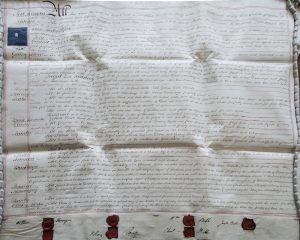
The contract for St John’s, (courtesy of The Suffolk Records Office in Bury St Edmunds).
The contract itself is exceptionally detailed, with strict measurements for quality control, defining, for example, the width of the masonry joins. The external facing was to be made of so-called ‘Suffolk white’ bricks from Woolpit and the interior with ‘red kiln burnt bricks’, which, despite their cost, were to be painted. All the bricks were to be laid in Flemish bond. Structural arches were to have an iron core covered with brick.
The contractees for the parish were Lord Arthur Hervey (Frederick’s son), Revd Augustus Asgill Colvile, Rector of nearby Great Livermere, and Henry Wilson, a local squire and the patron of St James. They would promise to take over inspecting the works and paying the instalments to the contractors. They assured their funders that they were not ‘aiming for any high degree of architectural beauty’. The contractors were Messrs Bell & Sons of Cambridge, who would take responsibility for all the furnishings, including pews, font, galleries, glazing, scaffolding and services.
The building work was financed entirely by public subscription, with gifts ranging from a couple of shillings to £100. The Lecturers of St James had noted that they hoped ‘the higher and middle classes in this town and neighbourhood’ would give, and, indeed, many did. Some gave anonymously, or were recorded under names such as ‘A Staunch Churchman’, ‘A Country Rector’ or even ‘A Widow’s Mite’. Many subscribers were members of the same family. In total, subscriptions raised nearly £5,000. The Church Building Society gave another £400 and the Guildhall Feoffment Trust, £300, while the ‘Ladies’ donated over £100 for ornaments including cushions, candlesticks and books. The Marquess of Bristol promised £100 a year for the living, the money coming from land in Little Saxham.
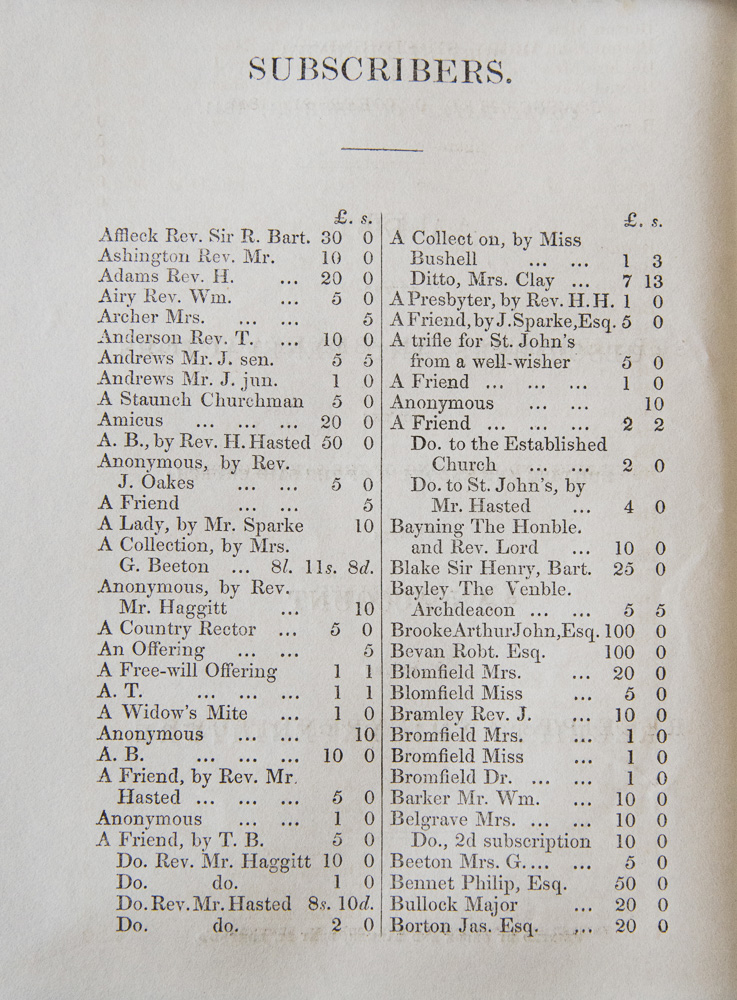
List of subscribers 1841, (courtesy of The Suffolk Records Office in Bury St Edmunds).
In addition to subscribers, the church also received major benefactions: £100 from the Marquess of Bristol and plate from his wife; an organ by Revd James Devereux Hustler; and books from the Society for Promoting Christian Knowledge (SPCK). However remarkable this fundraising model was, the total sum was not great for a whole church building: the famous ‘Church Building Act’ of 1818 often awarded more than this. St John’s would have to be built on a budget – and, indeed, Ranger would bring it in tightly within the necessary amount, at just under £6,000.
The laying of the Foundation Stone in July 1840 was celebrated as a major event. Staging was erected, music played – with over 600 children singing the Old Hundredth Psalm – and the children attending were given buns. William Ranger would produce a lithograph to memorialise it. The church organised a ritual carrying of gravel, which was donated by Thomas Cocksedge. It was carted by 28 men, including the Marquess of Bristol, the local MP and other important locals. The street was renamed, from Long Brackland to St John’s Street.
The church was to take little over a year to build, and Ranger kept to a tight schedule. He would be paid £362. Perhaps it was his experience as a builder and contractor in Brighton and London that helped him to manage this large project so effectively, but no doubt the desire to impress a powerful patron like the Marquess of Bristol, who had already employed him on a number of occasions, helped too. St John’s was consecrated in October 1841 by the Rt Revd Joseph Allen, the Bishop of Ely, along with not only Lord Bristol but also Lord Jermyn, his son, and the Duke of Rutland, who was staying with Bristol at the time. Two services were held: one ticketed in the morning and one open to all in the afternoon, led by Arthur Hervey, a future bishop of Bath and Wells. The offertory at the first service realised £211.5s (£211.25p).
The church was designed in a creative, loose version of the ‘Early English’ style of the 13th century, with grouped lancet windows and simple mouldings. It is about 90 by 40 feet in footprint, with nave, aisles, single-bay chancel and west tower. The extraordinary spire is 178 feet high. The nave is six bays in length, a significant number that represents both the days of creation and, as it has 12 piers, the Apostles. Originally, the porch that forms the bottom story of the tower was even more daring, with three open sides that had to be strengthened and reinforced in the 1870s.
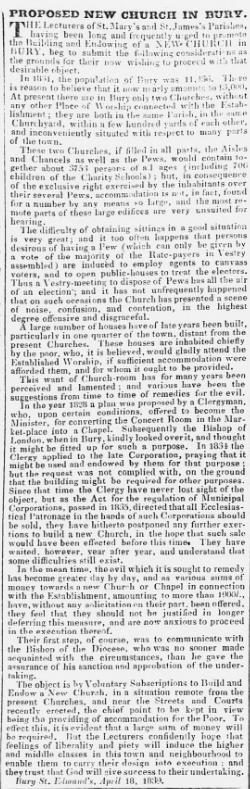
Bury and Norwich Post, Wednesday April 1839. Newspaper image © The British Library Board. All rights reserved. With thanks to The British Newspaper Archive (britishnewspaperarchive.co.uk). Please click this image to see the full version.
The timber vault in the nave is original and in the style of a medieval stone tierceron vault. It is, perhaps, the most remarkable architectural feature of the church’s interior. The original pews were of two kinds: doored, ‘box’ pews, for those purchasing them, and open benches for the free seats. They were in three blocks, one in the centre of the nave, the others overlapping between the aisles and the nave. A pulpit and desk of the same height were installed, ‘furnished in crimson drapery’, although a print reproduced in the Bury & Norwich Post in October 1841 suggests that the initial plan had been to have one very tall, for the giving of sermons, and one shorter, for reading scripture. At the western end, halfway up the tower arch, was a gallery with a large organ and space for the choir.
‘Gothic’ architecture, that is, the style of architecture that dominated during the European Middle Ages, had been enjoying a revival since the late 18th century. It was, however, becoming increasingly popular in the 1830s, and would enjoy almost universal popularity for church design from the 1840s onwards. Indeed, Ranger’s former boss, Charles Barry, was building the Palace of Westminster in a (mixed) Gothic style at the same time. Ranger would also adapt for use some of the latest building technology: not his own artificial stone but rather the use of cast-iron for the piers, so that they could be exceptionally slender in carrying the weight of the walls and roof.
The church’s ‘Early English’ version of Gothic was a style that had been recommended by Augustus Pugin, the influential architect and critic of the 1830s-40s, for use in low-cost churches because of its simple window design. Pugin would not have approved of the design’s lack of archaeological authenticity, however. During the 1840s, low buildings, with off-centred towers and long chancels became the architectural standard for Gothic churches, as a more ‘correct’ medieval design. St John’s, however, had the fanciful turrets and pinnacles, short chancel and perfect symmetry that were highly-prized in the early decades of the 19th century.
The church’s interior, with a very prominent pulpit and lectern, western choir gallery and ‘box’ pews, would also come under attack in the 1840s. It was well suited to the Evangelical influence that had predominated in the Anglican Church at the start of the century and which emphasised, not ritual at the altar, but the reading of scripture and its interpretation in sermons. A prominent pulpit and comfortable pews in a relatively plain building were all that was necessary.
Soon the ‘Catholic’ movement in the Church of England that was being fostered in Oxford and Cambridge from the 1830s would sweep England, with new values in art and architecture. As one of the last buildings in Regency Gothic, just as the new Victorian forms of Gothic were taking over, it is not surprising that many have written very disparagingly of the architecture of St John’s – it is, in many ways, a transitional building. Even the parish magazine claimed, in 1908, that in ‘the appearance of the church, which the most ardent lover of St John’s cannot call beautiful, the architect’s main object was evidently to erect an imposing spire, to which the rest of the building must be sacrificed’.
The opinion of contemporaries was perhaps more mixed: the Bury & Norwich Post called it a ‘beautiful object’ in October 1841; Wilkins’ 1867 guide to Bury St Edmunds called the spire ‘lofty and elegant’ (although it also misidentified the architectural style, cost and number of seats!); while Tymms’ of 1872 wrote that ‘the whole design of the church is extremely elegant, and the outline of the spire unusually beautiful’.
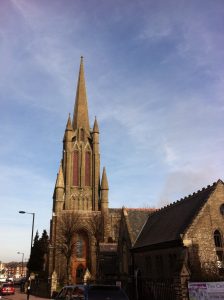 In numerical terms, the church was not an unqualified success: although ten years later, in 1851, the year St John’s became a separate parish, some 250 came to the morning service and 350 to the evening one, this still left the building typically around two-thirds empty (assuming the religious census of that year is correct in recording the seating capacity of the church as 850). In total about 7% of Bury’s church-going population came to St John’s, putting it alongside the mid-sized chapels but much less popular, of course, than the old Anglican churches. Things do not appear to have improved in subsequent years. By the 1870s, there were rarely more than 70 communicants in church on a Sunday.
Half the church’s pews were sold and half were free: paying congregants had to find about 10s (50p) a year for a seat, not an easy prospect for many in a poor parish. In fact, this did not even represent a very important source of income for the church, raising only about £27 a year. Its congregation was described as ‘almost exclusively of the working classes’ and the church faced challenges raising money for repairs – in the mid-1850s, for example, it had to rely again on the Marquess of Bristol for £500 to carry out repairs on the tower. He remained a loyal supporter of the church.
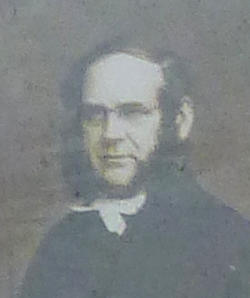
Revd Robert Rashdall.
For the first thirty years of its existence, the parish had one vicar: Robert Rashdall, who had grown up relatively locally, in Lavenham, where he had married the vicar’s daughter. He had studied at Corpus Christi College in Cambridge, a famous Evangelical college: his own religious practice was no doubt a good fit with its founders’ vision for St John’s. Corpus Christi was also a college with which the Hervey family had some association.