
The arrival of a new vicar, Stewart Holland, who had served as a curate at St James’s, spelled the start of a period of dramatic change for St John’s. From a church still in the Evangelical tradition that had dominated Regency England, the parish would be wholly reformed as a venue for ‘High’ Anglican worship in the Anglican Church’s Catholic tradition.
The interior would be wholly reimagined and refurbished and many new rituals introduced. Although Holland would not remain in Bury St Edmunds long enough to see his work rewarded, the congregation would swell under his successors, particularly Dr Thomas Stantial, when the church suffered serious overcrowding. Decline began by the early 20th century, however, and the church community suffered terrible losses during the First World War.
Show More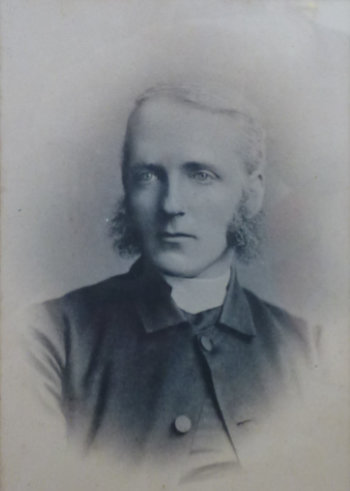
Revd Stewart Holland (1839-1909).
When Rashdall left St John’s in 1870 he was succeeded by a young curate from St James, Stewart Holland. Holland was strongly influenced by the now-well-established Catholicising trend in the Church of England known as Tractarianism, and would immediately set about refurbishing the church’s interior to facilitate a highly ritualised, ‘High Church’ form of worship. The Tractarian or Oxford Movement, which originated in the 1830s under the leadership of John Keble, John Henry Newman and others, believed that a sense of mystery and reverence needed to be restored to the worship and practices of the Church of England. They disliked what they saw as ‘Puritan’ influences in the Church.
The appointment of a high churchman to St John’s, directly after the evangelically-inclined Rashdall, is interesting. As the century wore on there was a trend across the country which saw a wider acceptance of ritualist practices. St Johns may have been reflecting this, although Suffolk’s long ‘low church’ tradition meant it would have been unusual in doing so. Another possibility is that Holland, as a younger priest – he was nearly 30 years Rashdall’s junior – was more conscious of wanting to keep in the mainstream than his predecessor, by then, perhaps, set in his ways. It is also not known how ‘low’ or ‘high’ Rashdall and Holland were, and therefore how severe, or otherwise, the shift from the one to the other might have been.
The key figure in the appointment of Holland to St John’s would have been the ‘patron’ of the parish and the owner of the legal right, the ‘advowson’, to appoint or recommend a new priest. This was the Bishop of Ely, and Edward Harold Browne, the bishop from 1864-73, was an enthusiastic and deeply-committed Tractarian who may have wanted to appoint as many priests of that stripe to his diocese as possible.
Browne had even been persecuted for his views as a curate in Exeter. While at Ely, Browne encouraged the work of the Additional Curates Society (ACS), a body committed to ‘put[ting] into practical effect the ideals of the Tractarian Movement by ensuring that the Christian Gospel should touch the lives of the poorest in the land’ including ‘people who were moving into the new industrial estates.’ ACS wanted to make sure that people in these new residential areas had ‘priests to teach the Christian Faith and minister among them providing the sacraments of the Church.’
Holland would clearly have met with his bishop’s approval, although how he himself came to embrace a Tractarian position is also unclear. His father, the Revd Thomas Agar Holland, sometime rector of Poynings in Sussex, was noted for his staunch anti-Catholic views, and the university where Stewart studied, Trinity College Dublin, had a policy of excluding Catholics from being elected to a Scholarship or Fellowship, or being made a Professor, in his time. He possibly encountered Tractarian views beyond his college in Dublin, given that Newman was rector of the Catholic University in the city for most of the 1850s, although Newman had probably departed the city by the time Holland arrived. It may also be of relevance that the Oxford Movement had strong connections with Suffolk, one of its earliest meetings being at the rectory of Hugh Rose in Hadleigh. The Rector of Stowlangtoft from 1832-1864, the Revd Samuel Rickards, was a close friend of Newman.
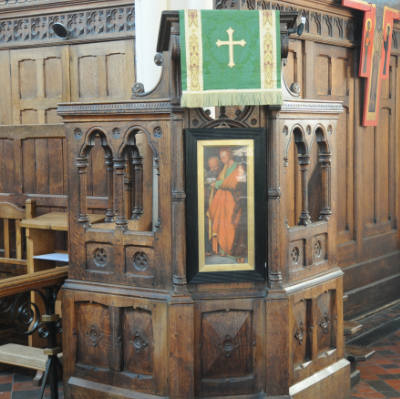 The changes at St John’s under Holland were far-reaching. In two stages, from 1873-75 and then 1875-77, the Vestry agreed that major new works were required on the church in order to fit it out ‘for the more devotional performance of Divine Worship’. They appointed the London architect, John Drayton Wyatt, the inspector of churches for the archdeaconry, to oversee the alterations. These changes would include new English oak bench pews throughout, in lieu of the old ‘box pews’; replacing the brick floor with encaustic tiles; and installing new chancel seats, an altar rail, hassocks (200 were obtained from Jones and Willis) and heating system. The timber vestry was also to be rebuilt in brick by Wyatt for £200. The west gallery, formerly home to the choir and organ, was removed in March 1873. A new pulpit was erected in 1880, designed by Wyatt.
The changes would cost £1,300, of which the bulk would be raised, like the church’s first construction, by donations. The largest sums came anonymously, but the vicar, curates, bishop, archdeacon, the MP, the Church Building Society, the Regius Professor of Divinity at Oxford and other local notables gave large sums. A new organ was funded, in part, by a series of sell-out concerts held in the church, featuring songs, serious and otherwise. A new reredos of alabaster and Cornish and Irish marble was donated anonymously and designed by Wyatt. A local newspaper, the Bury Free Press, reported in October 1876 that:
the one defect of the church is, undoubtedly, the want of a larger chancel, and this cannot well be removed; but as the next best thing a new reredos has been given by an anonymous donor, which very greatly improves the appearance of the east end of the church.
The chancel was extended by one bay to the west, within the church itself, as it was impossible to build eastwards, and it was opened at a celebratory service with a full choir on 12 October 1875. A year later, at Harvest Festival, the completion of works in the nave were celebrated at a service where the Bishop of Ely, James Woodford, preached and the Mayor and Corporation attended ‘in full state’. Woodford was a Tractarian like his predecessor, Browne. The church was decorated by ‘the ladies’ with ‘stringlets of corn and flowers’ that ran the height of the pillars. In addition, dishes of ‘choice fruits’, sheaves of corn and dahlias were laid on the altar, the reredos, font, pulpit and reading desks.
However important the changes to the fabric were, they were more than paralleled by changes to the church’s ritual life: the church would now be decorated at Easter and Christmas, Holy Communion would go from being a monthly event to being celebrated as often as 340 times a year, and the Te Deum was sung. The congregation turned to the east during the Creeds; the Kyries and Amens were sung, rather than said; and saints’ days were observed. First one and then a second assistant curate was hired to elaborate the ritual life of the church.
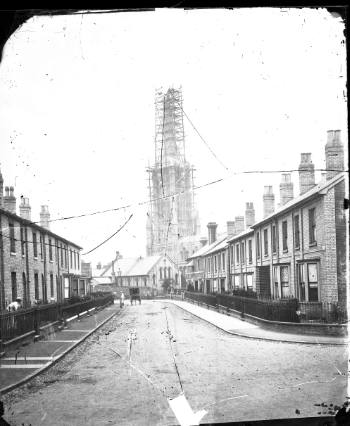
St John the Evangelist Church spire under repair, 1871. (Image courtesy of Suffolk Archives, Suffolk county Council.)
Just as importantly, and again often associated with the Anglo-Catholic movement, poor relief was reorganised and extended. Music was to become a central feature of the life of the church, now that the choir were moved from the west gallery to stalls in the chancel. In 1873, a choir was formed of ten men and twenty boys, who were paid and dressed in surplices, and a choirmaster, Thomas Smith, from the Church Music Society, was hired as organist. Smith would go on to compose several pieces for St John’s choir.
That year, the church held its first Friday ‘service for working men’, with about 50 people in attendance. Holland would also oversee a significant change in the parish’s book-keeping and organisation, keeping registers and starting a parish magazine. Like many parishes, St John’s had two churchwardens, one appointed by the vicar and one by the vestry at the annual vestry meeting held in Easter.
The infants school for 5-8 year olds, built along with the church in 1841, probably by William Ranger, was also extended at this time. In 1875 the main room was enlarged, and another classroom added, and in 1883 a further classroom was added by the masons. Toilets were built in 1894, and in 1899 a ‘new classroom’, as it became known, was added.
In 1896 there were 305 pupils, the majority being rather awkwardly housed inside the large main room, which was divided by screens and partitions into classrooms. Children were taught reading, ‘language training’ and ‘number’. During the First World War, the school was taken over by the Military, and, in 1918, the vicar of St John’s would address the children on the signing of the armistice. The vicar was always Chairman of the Governors and pupils were obliged to attend church for four festivals a year. The school fete was held in the vicarage gardens. The school would close in 1972, when it had just 48 pupils.
By 1876, the Bury Free Press reported proudly, the interior of the church was wholly changed: ‘the unsightly and uncomfortable pews have been replaced by open benches, the western gallery and organ loft have been removed’. The pews were to be strictly ‘first come first served’, rather than sold, an important issue in Anglican circles at this time – and St John’s was the only Anglican church in Bury that could boast this, albeit it seems to have taken a few years for this to become widely known. A few years later, the editor of the parish magazine could say with great satisfaction:
The Altar was radiant with splendid flowers. The Font… looked its best. Every other part decorated, bore the marks of loving, reverent, and skilful hands. The Pulpit, bright and striking, as usual, the Lectern, Faldstool [a portable folding chair], Prayer Desks, and Choir Stalls, all beautified; and even the window sills were not overlooked, but shewed that some one [sic] had spent much time and care, on them.
Stewart Holland would move to a parish in Cumbria in 1878 but, despite his short tenure, he left an indelible impression on the church, both physically and spiritually. Upon leaving the parish, Holland said he ‘felt it a duty to resign a charge which was overtaxing my strength’. When he died in 1909, the parish magazine noted that he ‘always took a kindly interest in his old parish here’, no doubt burdened by the memory of the deaths of his wife and eldest son during his time there. His two immediate successors, Charles Baker (1878-84) and Thomas Stantial (1884-1906), would not only be from the Anglo-Catholic wing of the church but would also oversee a great expansion in the number in the congregation, from around 70 communicants under Holland in the 1870s to over 300 in the 1890s, under Stantial.
This seems to have been a remarkable exception to trends across England as a whole: scholars such as Robin Gill have argued that church-going was beginning its long decline at this time, albeit ‘there were pockets of strong urban churchgoing’ at the end of the century. St John’s was helped, no doubt, by being located in a still-growing suburb of an industrialising town – but no doubt also by its highly educated and popular vicars, its commitment to poor relief and its growing and diversifying range of services and events.
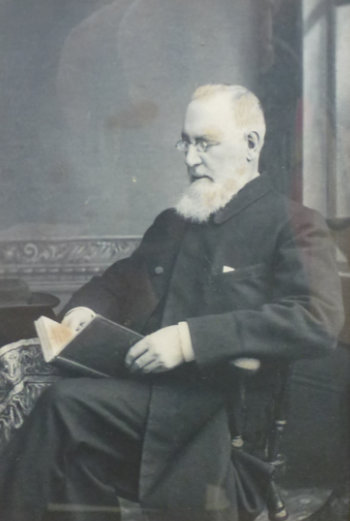
Revd Dr Thomas Stantial (1825-1906).
Both Baker and Stantial had studied at Oxford, where the latter attained a Doctorate of Civil Law. Although Stantial did not wear vestments when celebrating the Eucharist, his use of candles and adoption of an Eastward-facing position – that is, as if representing the people at the Altar – caused concern among some Protestant observers. In 1893 he had heard a rumour that ‘they spent money at St John’s in buying candles when the poor were starving’ – something he vociferously rejected. This suggests that ‘High Church’ worship in a poor parish was ruffling some feathers locally. Baker, similarly, wrote a series of articles for the parish magazine defending prayer to the saints and the real presence (the belief that Christ’s body and blood are fully present in the bread and wine of the Mass). Baker introduced a weekly 8.00 a.m. Communion and, in 1882, a daily celebration. This later lapsed.
Protestant opposition to what they saw as ‘ritualism’ was quite widespread at the turn of the century, and Bury became a focus when plans were drawn up in 1902 for a monument in the town to the ‘English Martyrs’, that is, Protestants put to death under Queen Mary in the 16th century. Although St John’s, as the highest church in Bury, was not targeted, Stantial caused concern when he argued that there were martyrs other than those whose deaths were to be commemorated – Catholics such as Thomas More and John Fisher, who were put to death under Henry VIII. At one stage it was proposed to erect the memorial in the parish of St John, at the junction of Northgate Street, Cannon Street and Long Brackland, the nearest site available to the place where the martyrs were believed to have suffered.
Stantial was also named, with others – including his son Arthur (then Rector of Bacton), a curate at St John’s, Revd F S Denett, and the Vicar of St James, Revd Hodges – in a document entitled ‘The Ritualistic Clergy List’, published in 1903. This ‘exposed’ those clergy who adopted any of the ‘Six Points of Ritual’ of which the authors disproved, including the Eastward position and use of candles. Stantial’s successor from 1906 to 1937, Ernest Williams Adams, a graduate of Hatfield Hall, Durham, would continue this tradition, writing in defence of the use of incense and vestments. Adams restarted the daily Eucharist on his arrival, and had a monthly choral Eucharist.
The church grew so popular under Stantial that it suffered from serious overcrowding, and thought was given again to enlargement. However, the site proved too constraining, and so in 1896 the church set up the ‘Lathbury Institute’, replacing the old Mission Room, using a generous legacy of £500 from Elizabeth Lathbury (1817-93). This offered a regular soup kitchen, and Stantial noted that at this time ‘many of the people who come to the church come from squalid homes’, although the area was becoming ever more genteel.
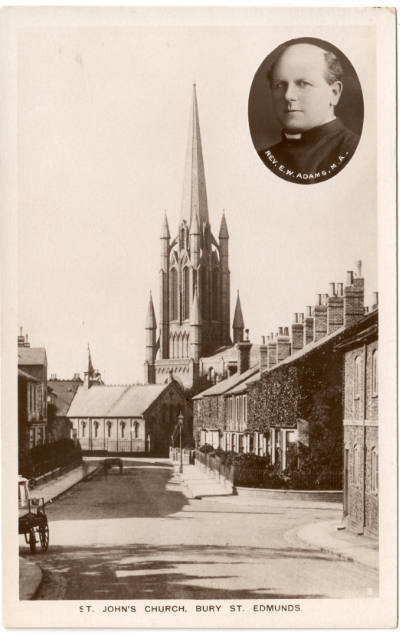
A postcard showing St John’s (exterior) and Rev Adams (inset), published by H A Cornish, Bury St Edmunds.
Stantial also reflected, when the Institute was officially opened, how expectations of the church had changed. No longer could a vicar discharge his duties just by holding services every Sunday and some weekdays, ‘a vast number of things must now-a-days be set at work in a parish – Mothers’ meetings, friendly societies, bands of hope, etc.’ He was grateful that Miss Lathbury had been wise enough to give the Vicar discretion regarding how her legacy was to be spent. In 1891, in a piece to mark the Church’s Jubilee, the Bury & Norwich Post noted that the Church had three Sunday Schools accommodating 300-400 children, three Bible classes, three mothers’ meetings, two ‘wards’ of the Communicants Guild and a branch of the Church of England Temperance Society.
Even with large congregations (the vestry reported some of 700-800) collections remained very small, often little more than a pound. There were numerous bequests in this time, witnessing the influx of people, money and enthusiasm: new altar crosses, stained glass windows, a silver baptismal shell, curtains, tiles, carpets and hassocks. The church was also wholly repainted in 1884 and a new fence erected in the churchyard. Dr Stantial’s widow gave a window to commemorate his death in 1906. It was made by Wiles and Strang of Newcastle, and showed Saints Peter and Andrew. This was ‘appropriate,’ noted the parish magazine, ‘as they represented the two fold aspect of the priest’s life – St Peter, the maintenance of the Faith, St Andrew, the ministerial side’. Nearly all the objects were given by individuals, but one window was funded by subscription, coming to some £135.
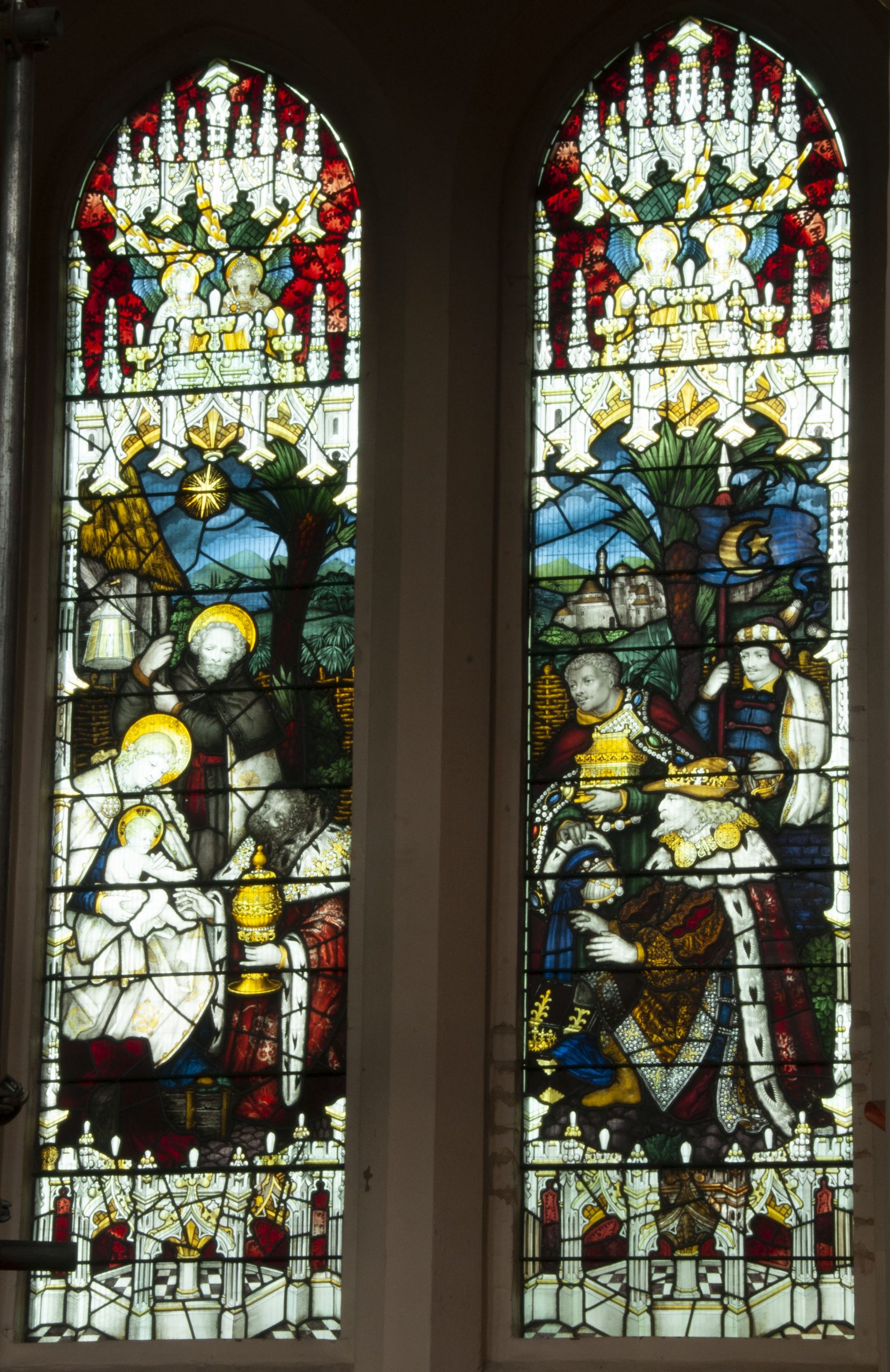
The window installed in memory of Lieut. Col. Arthur John Watson.
The church also benefited from the arrival of the 5th Suffolk Regiment, who would supply dozens of worshippers from the 1880s. In 1900, 200 volunteers would attend church before leaving for the Boer War in South Africa, and two years later, the widow of Colonel Arthur John Watson would donate a window by Kempe in honour of her husband who was killed in action at Rensburg in January 1900, aged 46. The parish magazine wrote that the window ‘is very beautiful and appears more so as one gets to know it better’. When the Suffolks left in 1906, the church magazine noted that ‘we shall miss them and it is some consolation to hear many of them say they will miss St Johns’. Nevertheless, by the turn of the 20th century, the number of congregants was falling back, dipping to almost the same levels as under Holland by the 1920s. Another installation in the Church at this time was a crucifix in memory of the Revd A. C. Leech, which was hung above the credence table in the sanctuary. Fr Leech was a curate at St John’s from 1903 until his death the following year, aged 38.
The Great War broke into life at St John’s with a terrible violence. News of deaths began arriving quickly: the first was Dr Stantial’s grandson Frank Evered Stantial, killed in May 1915 after only a few days of fighting. The vicar, E. W. Adams, lost his son in 1918, and a silver chalice and paten was donated in his honour in 1919. Adams also gave two massive oak candlesticks to stand on each side of the altar steps, in memory both of his son and of his late wife. A plaque to his son is also to be found in the chancel. Two church workers were killed: Albert Tweed, who sang in the choir, and James Elmer, a sidesman. The magazine, overwhelmed with news, reported the deaths of sons of the Olivers, Bascombes and Robinsons killed in 1917.
Grief was not the only impact the war had: the parish had to install blinds to keep the light from leaking out during evening services, for example, and to give gifts to valued members who went off to fight – a silver cigarette case to the organist. The Lathbury Institute was reformed as a ‘soldiers’ home’ for the town. The parish held a thanksgiving service for the Treaty of Versailles, and soon raised £70 for a war memorial: the Eagle Lectern, dedicated in 1920, the eagle being the emblem of St John. When it was unveiled, friends of the men who had died walked past the memorial during the service, leaving bunches of flowers on it. A Roll of Honour, containing some 122 names, was prepared by a member of the Bury School of Art.
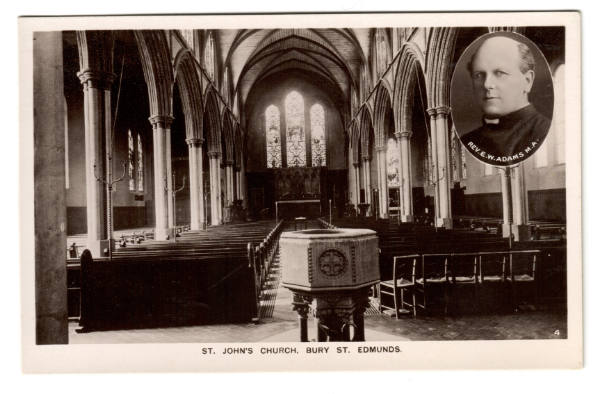
A postcard showing St John’s interior and Rev Adams (inset), published by H A Cornish, Bury St Edmunds.
There are also intriguing hints of the parish’s social life. In 1920, for example, the parish magazine noted that ‘the vicar will be glad if the people who persist in sending him anonymous letters about the misdoings of others… would give the money they waste on postage to the Free Will Offering Scheme’. In 1921, the magazine carried an argument against Christians supporting ‘strikes for higher wages and less hours of work’ – an opinion that may not have been widely shared in a working-class parish recovering from the economic effects of the war. In 1928, the church would hold a footballers’ service, to which all the local clubs were invited. The daughter of one long-serving churchwarden, Edward Alfred Pollard, gave a wrought-iron chancel screen by Barnards Ltd of Norwich to the church in commemoration of her father in 1927.