
The Church played an important part in healing the community after the War. People would come together for a variety of social and religious functions, and money was raised to provide outings for the children.
The Church and its ministers showed a special concern for both the spiritual and social wellbeing of young people, as well as developing a greater concern for ‘mission’ both at home and overseas.
Show MoreSocial activities
The Church developed a strong social programme in the inter-war years. The high spot each year was the Annual Garden Fete at the home of Dr Joseph Hinnell in Garland Street, but other smaller events were also arranged. The annual report for 1931 records that seven whist drives, five socials and two concerts were held that year, together with a dinner for choir members and servers. Sunday school outings were popular, often to seaside destinations such as Felixstowe (1931 and 1937), Clacton (1932) and Dovercourt (1935). When the children expressed a preference for the countryside, a local spot like Ingham would be chosen (1934).
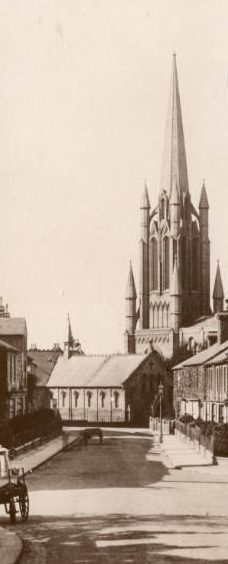
In 1925 the building was totally renovated. Three years later the spire was repaired. (Image from a postcard, originally published by H A Cornish, Bury St Edmunds.)
Money matters
The incentive for these events was a need to raise money as well as to provide opportunities for fellowship. The total profit from the whist drives, socials and concerts in 1931 was around £22, equivalent in purchasing power to nearly £1,500 eight decades later. Whist drives would also be held to raise funds to cover or subsidize the costs of children’s teas and outings.
Generally the Church was not flushed with money. Not long after the end of the First War the Parochial Church Council felt obliged ‘to bring before all who worship in the church’ its financial position.
At present, the ordinary Offertories and Collections are not nearly sufficient to pay the necessary expenses, which have considerably increased owing to increased prices. In addition to part of the payment of the stipend of one of the Clergy, the payment of the Organists, Choir, Verger and Organ-blower, Insurance, Coal, Gas, Cleaning and other absolutely necessary expenses for the carrying on the Services of the Church, it is obviously our duty to contribute to the funds of the Diocese, and this year we are asked to send £56. All in these days expect to pay more for their pleasures, and if our religion is worth anything at all, we must, in common honesty, be ready to pay more for our Spiritual Privileges.
In the 1930s the state of the accounts appears to have been less of a concern. More was being given through the offertory, and the garden fete and other events were producing a healthy profit. But the issue was always there, and into the 1950s the Vicar was reminding members of the heavy costs of running the Church and asking them to consider whether they were giving a fair proportion of their income to the Church.
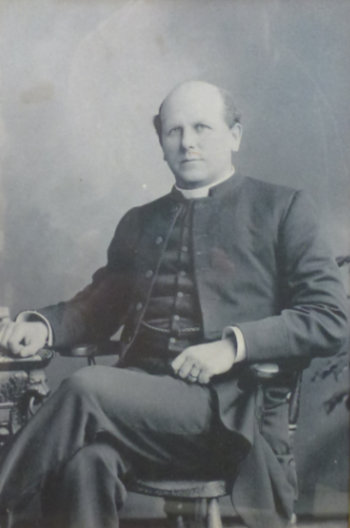
Canon Ernest Williams Adams (1862-1937).
A concern for mission
Towards the end of his 30-year tenure as Vicar of the parish, Canon Adams noted that, throughout his 50 years as a priest, he had always found it difficult to get people interested in missionary work. His latter years at St John’s saw a renewed interest in missions, however, with the Missionary Committee looking to expand by recruiting more men, and the Vicar being requested to book a speaker from a missionary society. When the idea that children put on plays was discussed in 1934, Miss Mary Ashwin suggested that missionary plays would help the children and their parents develop an interest in missions. In 1932 a bookcase was placed at the west end of the South Aisle to receive the Missionary Library. This was being used by a few members of the congregation, the PCC minutes recorded, although ‘it is much to be wished that many more would avail themselves of it.’ Despite its financial worries the Church was generous in its support of missionary organisations and charities. It gave faithfully to SPG – Society for the Propagation of the Gospel in Foreign Parts – over many decades, and continues today to support its current manifestation, United Society Partners in the Gospel.
Celebrating the Oxford Movement
The year 1933 saw the Church celebrate the centenary of the Oxford or ‘Tractarian’ Movement. This was the high church grouping which flourished in the nineteenth century and influenced earlier clergy at St John’s, including Stewart Holland. St John’s held a series of meetings and a special service to commemorate this anniversary, with the local press reporting Canon Adams saying he was ‘afraid perhaps the parish failed to realise that probably their church would not be in existence if it had not been for the movement.’ He would not have meant that the Oxford Movement inspired the foundation of St John’s: perhaps he felt that it was only because the church took the direction it did under Fr Holland that it had survived into the twentieth century.
The state of the building
In 1925 the building was totally renovated and redecorated at a cost of £300. Three years later the spire was repaired at a cost of £400. The money for these projects was raised by parishioners in 8 months.
An Archidiaconal Visitation on 14 May 1934 noted that the Church appeared to be in good repair, although the apex of the West and North side of the Vestry needed ‘a little attention’. ‘The interior is well kept, clean and tidy’, the report noted. The Archdeacon recommended that the Church take out an additional insurance policy as the current amount for which the building was insured, £13,200, did not seem adequate. ‘I was pleased to see the Church ground looking so well’, Archdeacon Maxwell-Gumbleton commented. ‘A tidy and well cared for Church ground is always a source of pride to Parishioners, and, in an indefinable way, has an effect upon the spiritual life of a Parish.’
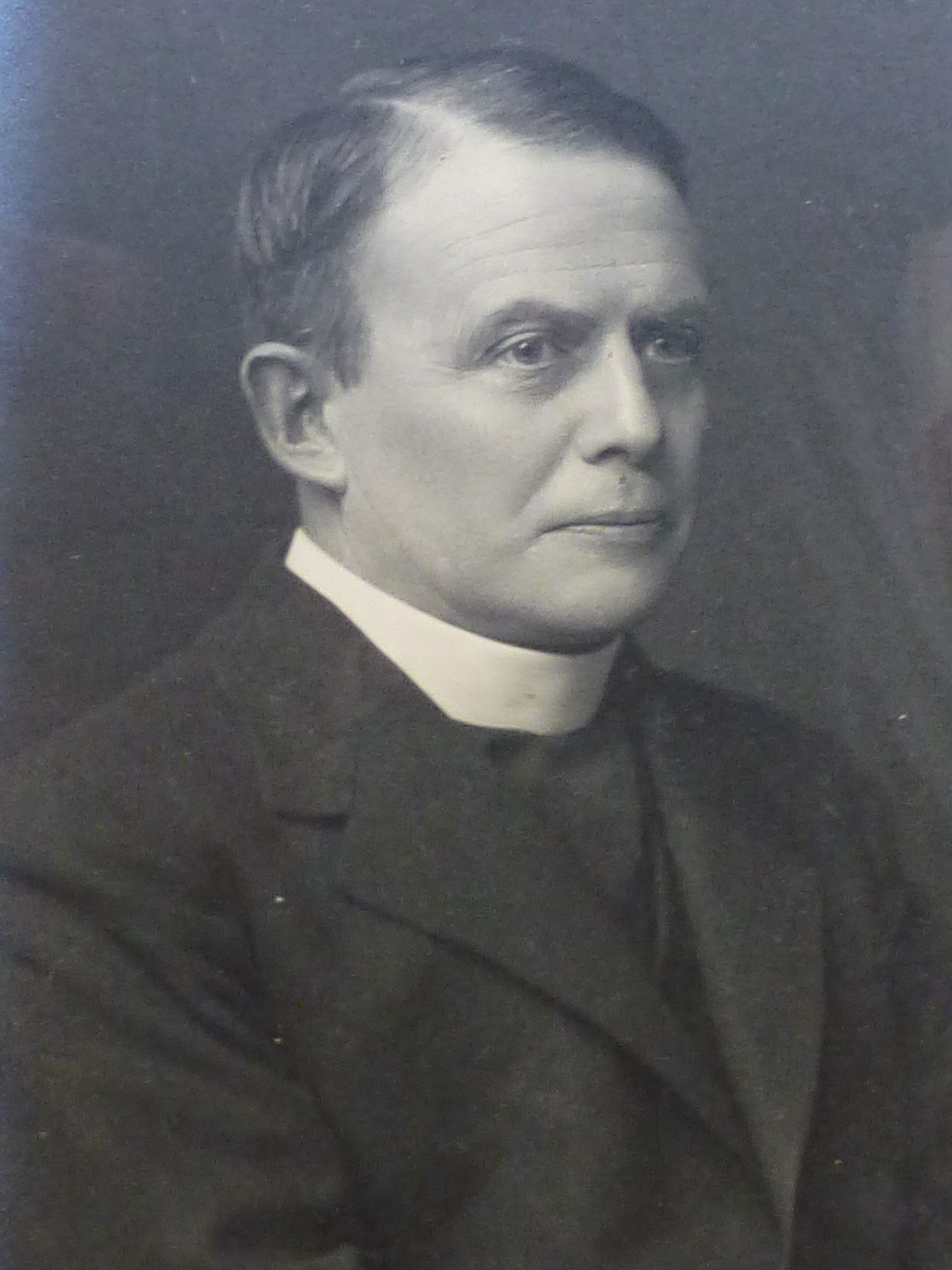
Revd Desmond George Brittain (1890-1943).
The spiritual development of the young
When Canon Adams died in January 1937, he brought to an end a period of remarkable continuity for the church: it had had only two vicars for the past 53 years. The Church Council, meeting shortly after Adams’ death, agreed ‘that the new incumbent should be someone who would make no drastic changes to the services.’ That new incumbent was the Reverend Desmond Brittain, who had served as a curate under Canon Adams. One of Fr Brittain’s priorities as the new Vicar was to develop the ‘spiritual side’ of the Sunday School ‘as well as the social’. He and the superintendents met to discuss the re-organisation of the school, and the lessons best suited to each grade. Fr Brittain said he hoped to see the school run ‘on more modern lines’, though he recognized it would take time to achieve this.
Another venture catering for the spiritual needs of the parish’s children was the King’s Messengers, started in the mid-1930s. This was described as a ‘Church of England version of the Girls’ and Boys’ Brigade’, and provided Bible teaching and guidance in the faith for young people and attempted to develop their interest in missions. The King’s Messengers met midweek and did not compete with the Sunday School.
A marked omission on Coronation Day
Surprise was expressed in the town when St John’s was one of few buildings not to show a flag on the day of the coronation of King George VI and Queen Elizabeth in May 1937. This absence was particularly marked given the dominance of the Church’s spire. Desmond Brittain wrote a hasty letter to the local paper explaining that the flagstaff was damaged the afternoon before and could not be restored in time. ‘A town which has given so charming a display of the outward symbols of loyalty is entitled to an explanation of so marked an omission’, Brittain wrote.
A memorial to Canon Adams
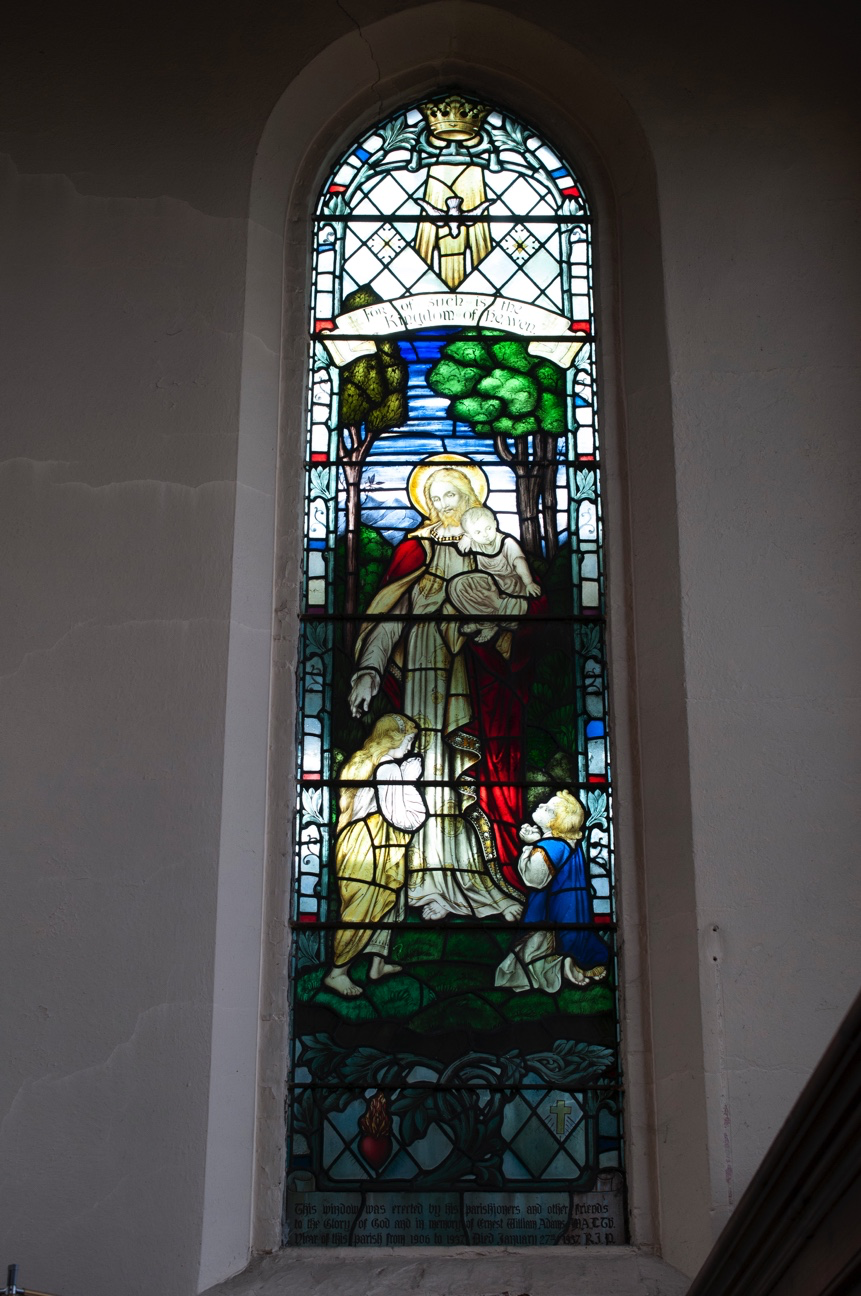
The Adams window.
The question of a suitable memorial for Canon Adams proved less than straightforward. The idea of a rood screen was rejected by the Bishop, who said no faculty could be granted for it, but he did agree to a stained glass window on the west wall of the North Aisle. The inscription chosen was the last few words of Matthew 19:14, where Jesus says (according to the King James Version), ‘Suffer little children, and forbid them not, to come unto me: for of such is the kingdom of heaven.’ Parishioners and friends of Canon Adams paid for the window, which is still the newest in the Church. So long did the process of agreeing to a memorial drag on that mention had to be made in the parish magazine of the intention to erect it for fear that people would think it would not happen.
‘The Recall to Religion’
Towards the end of 1937 the Bishop initiated a programme to boost church attendance called ‘The Recall to Religion’. In response, Fr Brittain proposed to take an evangelistic service on New Year’s Day, to launch an intensive campaign of visiting around the parish with the aim of reaching every house, and to inaugurate a ‘Men’s Service’. One member of the congregation suggested that congregations might be improved if the church were less draughty!