

The Church carried on its usual pattern of worship during the War, and although Fr Brittain’s departure caused some surprise, his successor, Fr Clement Ullathorne, brought a new sense of vision.
Show MoreWar did not interrupt the regular pattern of worship at St John’s, and between the 8.00 a.m. Mass and 11.00 a.m. Matins a simple Parish Mass was commenced each Sunday, aimed especially at younger people. Most of the other activities ceased in the early months of the war, and the Lathbury Institute was commandeered for use by the Army. When the Church obtained temporary use of the hall of St Michael’s Church of England College for Girls in Northgate Street, a private school run by Anglican nuns, the Brownies and a youth club restarted. A newly-recruited assistant curate, Fr Julian Rudd, built up a Scout troop. The Sunday School and Youth Fellowship operated during the war.
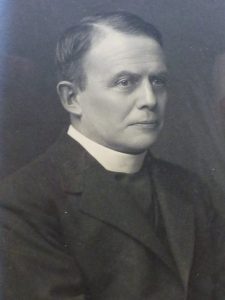
Fr Brittain.
Resignation of Fr Brittain
In December 1941 Fr Brittain told the Church Council he had handed in his resignation with effect from early the following year. His resignation took effect from 31st January. His departure may not have been entirely amicable, as he accompanied his announcement with a comment about some financial problems in the Church being due to ‘bad book keeping and folly.’ At a meeting of the Council nine days later it was proposed that a letter of appreciation for the work Fr Brittain had done in the parish be sent to him but, ‘after a lengthy discussion’, it was agreed the letter ‘be left on the table.’ A proposal was then carried that the secretary write to the Vicar saying that, ‘had he acquainted the Church officials when he found he was in difficulties they would have tried to help him out of his trouble.’
No information about Fr Brittain’s apparent ‘difficulties’ is offered, but he was known to have endured shell-shock in the First World War. He may also have experienced what is now known as myalgic encephalomyelitis (ME) or chronic fatigue syndrome (CFS). He died aged 53, his death certificate suggesting he suffered from dangerously high blood pressure.
Some gifts were presented to the Vicar upon his departure, including a glass bowl and illuminated address from the Young Communicants’ Guild, and a gold cross and chain from the St John’s branch of the Mothers’ Union.
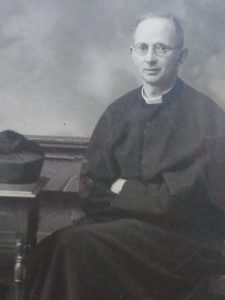
Fr Ullathorne.
Father Ullathorne
Brittain’s successor was Fr W. A. Clement Ullathorne. Ullathorne maintained the high church tradition of St John’s, although some thought he brought in changes too hastily. He had a fondness for vestments, and encouraged the whole congregation to process around the church every Sunday. Shortly after his arrival he introduced a Daily Mass, and obtained a faculty for an aumbry so that the Blessed Sacrament, the bread and wine which had been consecrated at the Mass, could be perpetually reserved. An aumbry lamp was given to the Church in memory of Janet Phillips in 2011.
Another of Fr Ullathorne’s innovations was to transfer the patronal festival from 27 December (the Saint’s day of St John the Evangelist) to 6 May (St John Ante Portam), presumably to save it from being overshadowed by the Christmas festivities. This practice survived until the 1970s.
One of the Church’s curates died in heroic circumstances while serving as an army chaplain during the war. A prayer desk in the south aisle is inscribed ‘John Arthur Newson, former assistant priest, who died in Normandy trying to save others, 20th July 1944’. Newson is buried in the Bayeux War Cemetery and immortalised on the Little Waldingfield War Memorial.
As the war drew to a close, some members of the Church welcomed Prisoners of War to their homes for tea on Sunday afternoons. This was part of the process of aiding the PoWs’ rehabilitation.