
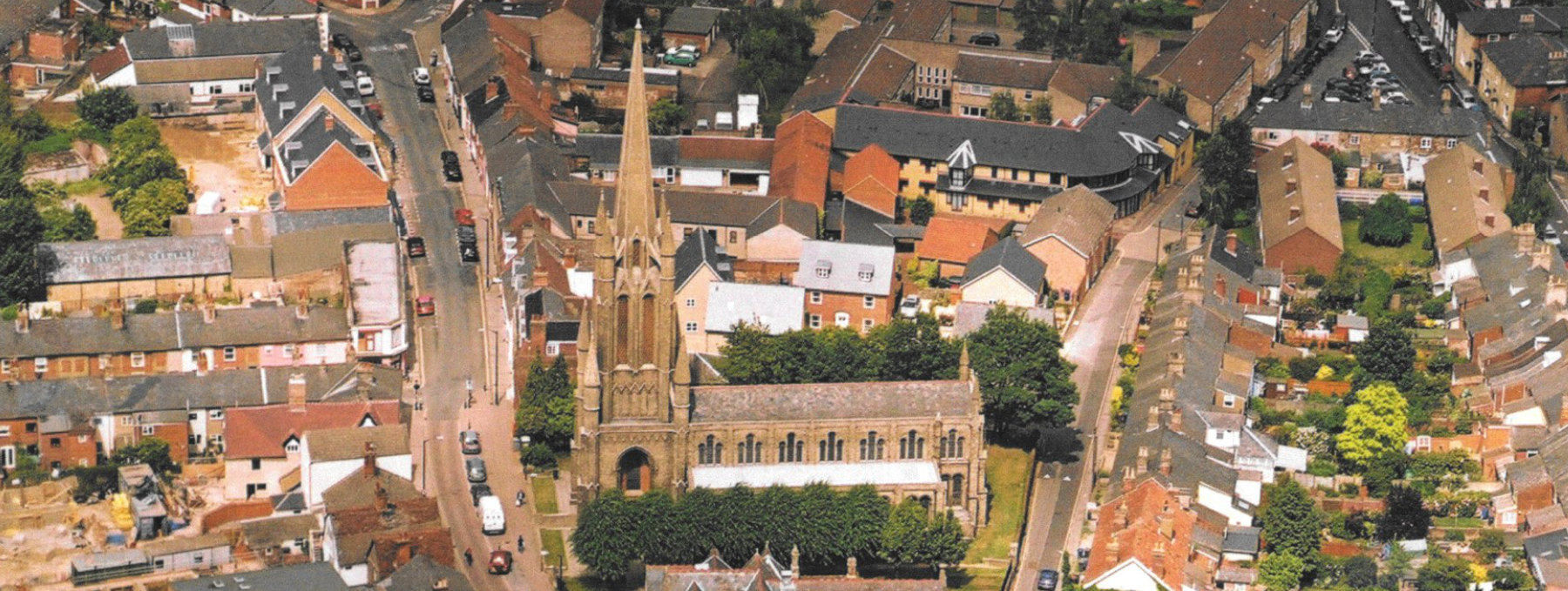
Even more so that after the First War, the Church proved to be significant social hub in the decades following 1945. Changes were proposed to aspects of the Church’s worship, a new vicarage was purchased, closer links with another Church in the town were attempted, and St John’s itself was saved from closure. Its school could not avoid that fate, however, closing in the early 1970s. Later that same decade the Church, town and wider community were shocked by the tragic death of a steeplejack working on the Church’s spire.
Show More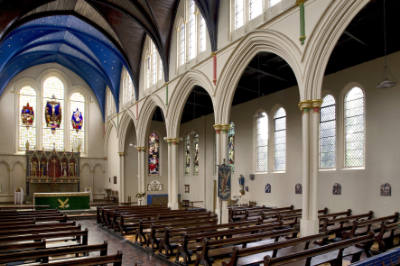
St John’s interior.
Soon after the war ended the church underwent a complete redecoration, and a legacy enabled the commissioning of new ornaments for the High Altar and statues for the reredos.
The congregation after the Second World War was not large but contained a good social mix of tradespeople and professionals. There was a robed all-male choir, with Evensong as well as sung morning services every Sunday. Choir members would be paid a small amount weekly, with a larger sum for weddings. Around 80 children attended the Sunday School in the afternoons, with classes dotted around the church. Boys and girls were taught separately. At a time when many children did not routinely get taken to the seaside or into the country, an incentive to attend was the Sunday School outing held every Whit Monday.
The Church at the heart of the community
For many people St John’s became a major part of their life. Activities were held almost every night of the week, and people could find themselves spending more evenings in the Lathbury Institute (now back in use) than at home. Activities included Brownies and Girl Guides, youth clubs for both girls and boys, a drama group, old time dancing and tennis – the table variety in the winter and lawn tennis in the summer. Membership of some groups, for example the Brownies and Girl Guides, was limited to members of the congregation, which could be an incentive to attend Church. There was a Church parade for uniformed organizations on the first Sunday of every month, and one year the Guides won a shield awarded by the county organization.
The Mothers’ Union was popular, and a version for younger women was also started, named the Fellowship of St Monica. This was a reference to Monica of Hippo, the mother of St Augustine. The Church had a branch of the Guild of St Raphael, which promoted a Christian healing ministry, and of the Confraternity of the Blessed Sacrament, a high church devotional society dedicated to venerating the real presence of Christ in the elements of bread and wine in the Eucharist.
Christmas was a very social time of the year, with a pantomime performed by the Sunday School, a party, and a nativity play involving adults and children. The Church fete in June continued to be a big draw and a major fundraiser, and one year the opening ceremony was performed by the Marchioness of Bristol, maintaining a link with the family which founded the Church. Dances were held, using a marquee borrowed from the brewers Greene King, as well as social events at which people would do their ‘party pieces’.
The question of incense
Four years into Fr Ullathorne’s incumbency, in June 1946, a major change to the Church’s pattern of worship was proposed at the Parochial Church Council. This was the introduction of ‘the ceremonial use of incense at the offering of the Holy Eucharist on Sundays and Red Letter Feasts, and on such other occasions as [the Vicar] may wish.’ The idea was not unanimously welcomed, even when it was suggested the change could be confined to the 9.30 a.m. celebration. Four months later a proposal to rescind the original proposal was moved, and the discussion was obviously lively. The member proposing the rescindment, Mr Houghton, recalled that he was one of those who, following Fr Brittain’s departure, had asked the Bishop for a ‘moderate high churchman’. ‘If Mr Houghton had known that things were coming to the present proposal’, the minutes record, ‘he would not have agreed to the Vicar’s appointment.’ Mr Houghton’s proposal was narrowly defeated, but by the end of the year Fr Ullathorne had decided that, ‘for the general good of the parish it were best that incense should not be used at present for usual parochial services.’ It would be allowed if other bodies using St John’s for their services desired its use.
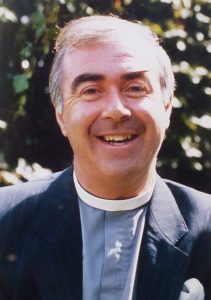
Fr David Williams.
The practice of using incense only for major festivals was maintained until the time of Fr David Williams (1969-85). Williams used incense at regular Sunday Mass and introduced the procedure of ‘three sacred ministers’, a deacon and sub-deacon in addition to the presiding priest. Both practices have continued to the present day.
Lightning strikes
On 12 June 1946 the Church was struck by lightning, necessitating the installation of a new lightning conductor. This was the third time the spire had suffered this fate, the previous occasions being 1871 and 1896. No structural damage was done to the spire, but the contractors carried out a thorough examination of the tower, roofs, west porch, nave and other parts of the building, repairing brickwork, leadwork, slating, glass, electrics and other damaged areas as necessary. One pupil at the school recalls the weathercock from the church spire falling into the playground as a consequence of the lightning strike. Ironically, a popular game at the school was called ‘St John’s spire is falling down’. This involved staring up at the church spire and getting dizzy as the clouds went by.
Two new statues, an altar and a cross
Fr Ullathorne was responsible for the installation of the statue of St Michael in the North Aisle. Given in memory of Cecil Hazell, who died on active service in 1944, the statue was formerly in a niche at St Michael’s College in Northgate Street. When the school closed, Ullathorne brought it to St John’s and had a shelf made in Hazell’s honour. Members of the school used to march to St John’s for services. Fr Ullathorne also secured the altar from St Michael’s, installing it in the Lady Chapel. Carpets and hangings were added to the Chapel, paid for in part by clothing coupons contributed by the congregation. There was a St Michael’s Chapel in the North Aisle until, in March 1994, its altar was destroyed by fire. This sad event occurred, ironically, on Ash Wednesday.
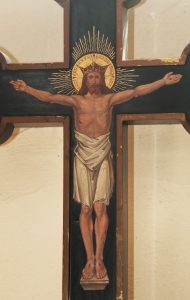
War Memorial Cross.
A minor controversy occurred in 1947 when a Black Cross which had been donated to the Church was removed to the Vestry when new ornaments were placed on the Altar. The family which had gifted it objected to its removal and threatened to take it away from the Church altogether. When told that the Cross would be used during Advent and Lent, the family replied that they would send representatives to visit the Church to make sure this undertaking was carried out. This now forms part of the War Memorial corner at the back of the south aisle.
1947 also saw the first use of incense in St John’s, and at the Church Union Festival in 1949 the first High Mass in the church’s history was sung. The Church Union is a body committed to promoting a Catholic interpretation of the Church’s faith.
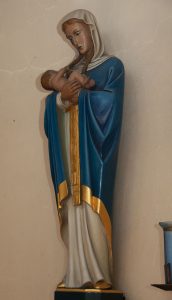
The statue of the Madonna and Child, installed in the South Aisle in memory of former churchwarden, Russell Pitcher.
In 1948 a statue of the Madonna and Child was installed in the South Aisle in memory of a much-respected former churchwarden, Russell Pitcher, who had died in March 1947. Pitcher was Borough Treasurer of Bury St Edmunds.
In the aftermath of the War, Fr Ullathorne began corresponding with an Old Catholic parish in Southern Germany. St John’s ‘adopted’ the parish and sent them items to replace those destroyed during air raids. These ranged from children’s toys to altar linen for their church.
One of Fr Ullathorne’s housekeepers, Mrs Storey, began a small private school with about 10 pupils. It met in the mornings only, with Mrs Storey as the only teacher until a second was appointed.
At the time of Fr Ullathorne’s departure the Bishop observed that, when he had arrived, the Church had been at a very low ebb. ‘Mr U had done a splendid job in bringing life and vitality into the Church and parish’, he said.
A new vicarage
During the tenure of Fr Ullathorne’s successor, Fr Roy Southwell, a new vicarage was purchased. Fr Southwell did not take to the house which had served his predecessors, 54 St John’s Street, next door to the Church, and expressed a wish to move to a more modest dwelling. Property at 37 Well Street was chosen.
The report from the estate agents who were asked to market the vicarage casts an interesting light on how the parish was viewed in the mid-1950s. ‘This will be a difficult property to sell advantageously’, the agents told the Church Commissioners,
St John’s Street is not a popular area of the Borough, and the houses in the vicinity are, for the most part, small dwelling-houses. Consequently, the Vicarage has not the benefit of being situated in a favoured residential locality, nor is St John’s Street looked upon as a popular shopping area.
The surveyor was also none too impressed with the structure of the house itself which, at the time the church was built, had been a pub.
The greater proportion of the roof is of heavy glazed pantile construction, and the ‘thrust’ from this course has bulged in places the brick with which the major portion of the external walls is faced. Nor is the lay-out of the accommodation on the ground floor easy to run. The domestic quarters are by no means satisfactory, and the large drawing-room at the end of the house is altogether too big and lofty to keep warm at the present price of fuel.
The agents thought the Church might get around £1,500 for the property but suggested it be marketed at £2,000 to avoid arousing suspicions that it was, in fact, not worth much!
The asking price for Well Street was £2,650, and the Church found the extra money needed from a variety of sources, including a loan from the Church Commissioners, the Vicar’s discretionary fund and its own reserves.
The Church maintained its programme of activities during Fr Southwell’s time, benefitting much from the enthusiasm of a young curate, Fr Michael Goymour. Goymour was very popular during his short spell at St John’s, and helped build up several of its clubs and organizations.
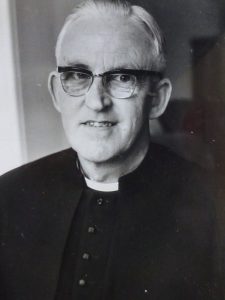
Fr. John Peach.
Ups and downs in the 1960s
When Fr Southwell left in 1956 he was replaced by Fr John Peach, whose reports for the early years of the 1960s suggest the Church was going through a difficult patch. Attendances at midweek services had declined, response to a Lent course supplied by SPG had been disappointing, and key workers had been lost through death and removal. In the seven years from 1954 the number of baptisms fell from just over 3 per month to 2.4. But there were also encouragements: a Guide company had been re-established, with hopes also that a Brownie pack would be re-started, and a Men’s Group was showing signs of making a contribution to the life of the parish. The King’s Messengers was revived about 1960, the earlier incarnation having folded some years before, and a youth club was re-started on Saturday evenings. Leaders of the King’s Messengers included Miss Dorothy Eden, Mrs Barbara Mallender and Mrs Annie Bareham. Discussion groups proposed a parish visitation by laypeople, and more missionary evenings to share news about the Church in different parts of the world.
Later in the decade were attempts, first to link St John’s with another church in the town, St Mary’s, and then to close it altogether. The relationship with the more evangelically-inclined St Mary’s was described in the first editorial of a new jointly-produced magazine, Tower and Spire, as ‘rubbing shoulders’. While hoping to practise some measure of unity, the article explained, the two churches recognize that they are ‘very different from one another’ and ‘take a pride and pleasure in their own individual approach to religious matters.’ The plan did not work, and when Fr Peach left in 1968, the diocese drew up plans to close the Church. Numbers had thinned considerably over the preceding years, but the Archdeacon firmly opposed the idea and the Church survived. The Archdeacon’s faith appeared to be vindicated when, under Peach’s successor, Fr David Williams, numbers began to pick up.
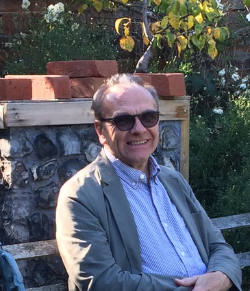
Adrian Mann, who edited The Bridge church magazine.
The attempted closer relationship with St Mary’s reflected St John’s strong ecumenical outlook. The Church had been involved with the local council of the British Council of Churches since its earliest days during the Second World War, and in the 1970s the Vicar, Fr David Williams, chaired its committee. In the late 1970s the magazine of the Bury churches, The Bridge, was edited by a member of St John’s, Adrian Mann. Something of the church’s passion for church unity can be seen in an article Fr Peach wrote for the church magazine in 1960 following the historic first meeting between an Archbishop of Canterbury and a Pope since the Reformation. This was ‘a meeting for which every Christian should give thanks [and which] should serve to quicken our prayers during the [forthcoming] Universal Week of Prayer for Christian Unity’, Peach wrote.
The Church got into an awkward spot in the 1960s when it accepted, in good faith, the gift of a chalice and paten in memory of a longstanding and distinguished member of the congregation, Miss Mary Barnardiston. The items had been created by one of the country’s leading goldsmiths, John Grenville, following a commission by Miss Barnardiston’s niece, but shortly before they were due to be presented to the Church a piece about them appeared in the East Anglian Daily Times. Spotting this, and discovering that Fr Peach had not applied for the necessary faculty to place these items in the Church, the Archdeacon advised Peach to do so. But when Peach duly applied, he was told that a faculty would only be granted if the inscription on the items were removed. The problem lay in the words suggesting Miss Barnardiston was ‘commonly believed to be a saint.’ No reason was given for the objection to these words, and understandably the niece who had arranged the gift was very upset. The Church was advised that a formal hearing could be requested, at which the ‘theological acceptability’ of the inscription could be examined, but this would involve considerable cost. Eventually the gift was returned to the donor and is now on display in the Victoria and Albert Museum.
The nuisance caused by pigeons reached a high point in the mid-1960s. Advice was sought from the RSPCA, Pigeon Racing Club and the local council regarding how to get rid of them, and in desperation Fr Peach asked the police for permission to shoot them. The police advised that shooting was not allowed within 50 feet of the roadway. The worst effects of the birds were overcome by placing wire netting over the three doorways, but they remained faithful attenders at the Church. In the 2000s a contractor working to install similar netting at the Church brought along a chained Harris Hawk to keep pigeons from impeding his work.
Closure of St John’s School
The 1970s saw the closure of the school after more than 130 years. The change to a comprehensive system of education in 1971 brought in primary schools, merging ‘infant’ and ‘junior’ departments, and St John’s was one of many infant schools which did not survive.
The school had always enjoyed close links with the Church. Successive Vicars served as Chairs of the Managers or Governors and would regularly visit to take prayers, give Scripture lessons and prepare pupils for Confirmation. Pupils would also be encouraged to lead worship in the school, and would attend Church on important feast days and for a harvest festival. A final service of thanksgiving for the life and work of the school, attended by parents, staff and children, was held in the Church on 19 June 1972.
The following year the building was converted for use as a community centre, known as the St John’s Centre or just ‘The Centre’. The premises were to be used for the benefit of children and adults in the town, with permitted activities including a Sunday school, evening classes, ‘physical and mental recreation’, a nursery school and ‘the advancement of education by means of a library or reading room.’ The initial clean-up of the building, after it had been closed for about a year, was carried out by a group of teenagers who wanted to hold regular discos there. Inmates from a local prison helped with the painting as part of their rehabilitation process.
Removing pews, and Benediction
A change to the layout of the Church was made in 1976 when three rear pews in the North Aisle were removed to create space for a bookstall. The Vicar, Fr David Williams, had originally proposed removing pews from both the north and south aisles, but objections were raised by several members.
The same year the Church discussed the issue of Benediction of the Blessed Sacrament, which took place after Evensong on Sunday evenings. An objection to this form of inviting God’s blessing, which involves making the sign of the cross over the congregation with the exposed sacrament, had been made by the Bishop, who preferred Devotions before the Blessed Sacrament. The minutes of a PCC meeting on 10 June note that this issue became ‘a focus for the broader discontent in the church’, with some members ‘deeply unhappy at present trends’. It was agreed to find out what theological objections the Bishop had to Benediction. The original practice continued during the remainder of Fr Williams’ time.
During Fr Williams’ period of office, prominence was given to three major festivals: Corpus Christi, which honours the Body of Christ; All Souls; and Candlemas, which commemorates the Presentation of Jesus at the Temple. This practice remains to this day.
A tragic death
The following year a steeplejack named Jack Baker died while inspecting the spire. A very experienced worker, and father of five children, Baker had returned on a Saturday morning to finish off a piece of work when the rope he was using pulled the pinnacle of the spire down on top of him, burying him in the rubble. Fr Williams climbed up to give the steeplejack the last rites, and he died later in hospital. The anniversary of Baker’s death, 8 October, is remembered by the Church and Mr Baker’s family every year.
A mixed choir
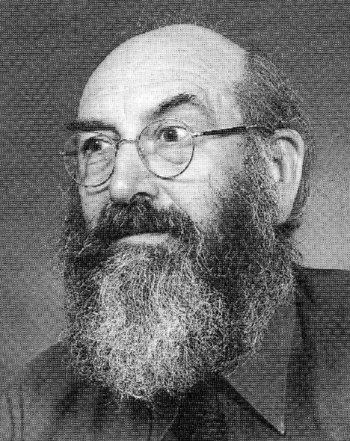
Choirmaster, John Fry.
In the late 1970s women and girls were accepted into the choir. They were not allowed to wear black cassocks in the Chancel, so made themselves blue gowns after holding a sponsored walk to raise funds for the fabric.
The choir continued until the resignation of its popular and inspirational choirmaster, John Fry, in the 1980s after nine years. Fry accepted an invitation to join the choir at the Cathedral. Fry founded the Abbot Consort at the Church in 1973. A more recent choir, the St John’s Chamber Choir, now contributes to Sunday worship at the church once a month.
The departure of Fr Williams and arrival of Fr Pettitt
In 1986 Fr Williams was convicted and imprisoned for sexual abuse against a young server at St John’s. His replacement was Fr Simon Pettitt, who had previously been schools officer for the diocese. Pettitt inherited the fallout from Williams’ crimes, including a reduced congregation and a greatly diminished reputation for the Church. Attendance at St John’s never recovered to the levels it had known under Fr Williams, who until his behaviour was discovered was a popular and much-respected parish priest. The incident was known to have had a serious effect on the life of the young man concerned.
In one of his first annual reports, Fr Pettitt said he had inherited a ‘strange parish’. He cited two reasons for this observation: its size – it was a small parish with no capacity to spread out and grow; and the number of people attending the church who lived away from the parish. These tended to be younger, more active and involved in many other areas of life, while those living in the parish were more elderly. In fact, almost all on the parish roll live in Bury St Edmunds, and about half in the parish itself. One comment by Fr Pettitt suggests that a radical shift in the church’s role in the parish had occurred since the decades immediately following the Second World War. ‘We do seem to have a parish where our basic focus is on our Sunday Morning worship’, he wrote, ‘and little seems to happen during the week.’ The loss of the School had reduced the Church’s influence in the parish, but many of the activities it offered would have increasingly been seen as ‘out-of-date’ in the late 1980s.
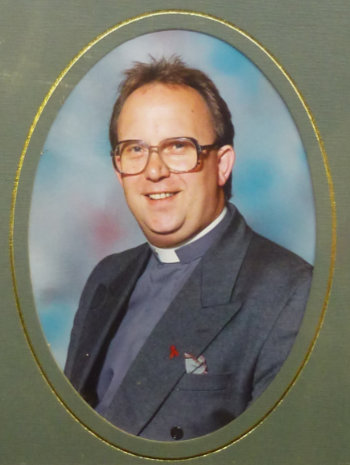
Fr Pettitt.
Fr Pettitt became the first Vicar of St John’s to switch from adopting the ‘eastward position’ during the Mass to standing behind the Altar facing the people. The ‘eastward position’ has been a traditional feature of high church worship, involving the priest turning his back on the laity to symbolize, as some believe, his acting as Christ’s representative offering the sacrifice of Christ to God. Liturgical reform was also occurring in the Roman Catholic Church at this time. St John’s could be said to be fortunate in that, not having been built as an Anglo Catholic Church, it is more suitable for modern Catholic worship than Churches built at the height of the Oxford Movement in the mid- to late-19th century.
In the 1980s the Church adopted a stewardship/pastoral visiting initiative introduced by churchwarden Roy Rex. This enabled the congregation to give regularly, and still bears fruit. Currently the Church is able to send in excess of £40,000 as its Parish Share contribution to the diocese each year. Roy Rex was also responsible for introducing the idea of an annual parish retreat, a practice that continues to the present day.