
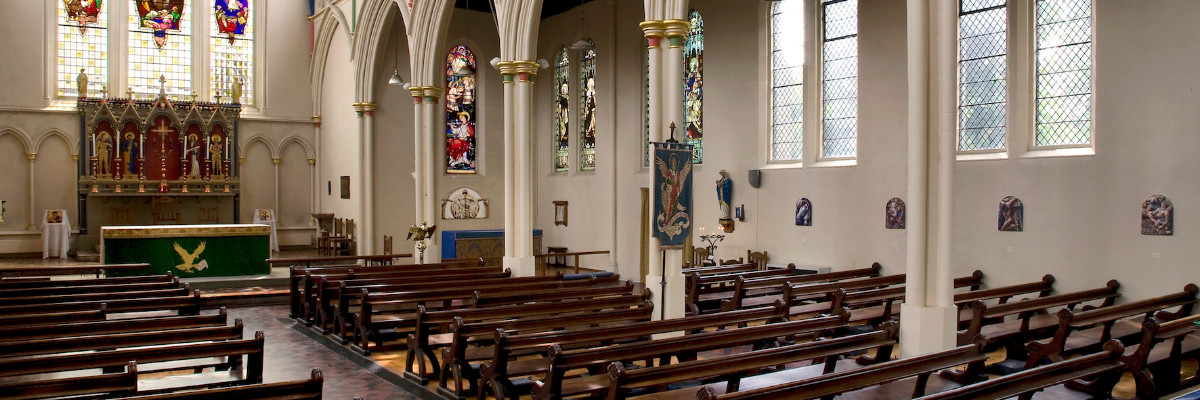
As the end of the millennium approached the Church took stock of both its spiritual and physical resources. New styles of worship were introduced, the Church was served by its first woman priest, and St John’s became one of ten churches in a larger team ministry. An exciting new purpose was found for the former school buildings, and some striking new ‘stations of the cross’ were installed in the Church.
A fresh vision…
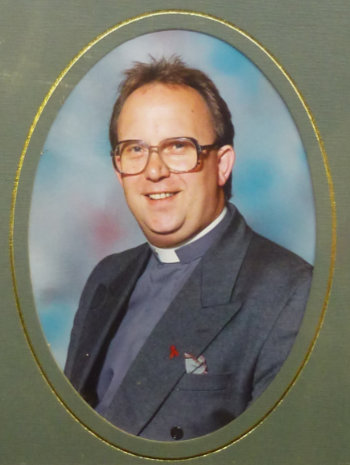
Fr Pettitt.
In the early 1990s the Church decided to look to the future, both in terms of how it could preserve its premises, and what spiritual vision might guide it.
In terms of the structure, Fr Pettitt summed up the situation by saying that the Church had been aware for some time that they were
the guardians of three crumbling Victorian buildings. The Lathbury Institute, which although now is used for a night shelter in the winter months does not fulfil any other purpose and is deteriorating rapidly. The St John’s Centre which although given a bit of a facelift a few years ago needs a considerable amount of work done to it to bring it to the standards demanded today, and of course the church which needs a considerable amount of restoration work, particularly to the spire along with a new heating and lighting system.
He was not being pessimistic, however, asserting that ‘we are at the beginning of a very important and very exciting stage in the life of St John’s.’ Although he spoke only in passing of the Lathbury’s use as a night shelter, this was an example of the Church showing Christian love to a marginalized section of the community. It also showed the Church being prepared to take risks, since those availing themselves of its hospitality could display challenging behaviour, including the use of drugs. The shelter was not established with any evangelistic intent, but some of the homeless people came to the services.
To address the structural issues the Church commissioned a professional feasibility study and fundraising proposal. This recommended the complete restoration of the exterior of the church to make it serviceable for another 150 years, and modifications to the interior ‘to enable the building to be fully used for religious and cultural purposes’. It also proposed converting the former school into a church hall/community centre to replace the Lathbury Hall, and linking the church and the centre to provide a social centre for all ages. The cost was estimated to be over a quarter of a million pounds, to which would be added the firm’s not insubstantial fees for advice on fundraising. This amounted to a focus on direct giving rather than small fundraising events.
The Church managed to raise about half of the required amount, and was disappointed that neither the county nor borough council was willing to contribute. The restoration of the Church was carried out, but the more imaginative new schemes were shelved. With the Church no longer having a choir, the choir stalls were removed and the Altar brought forward, a move in harmony with Fr Pettitt’s decision to stand behind it during Mass. This made the Church more suitable for concerts, and it probably has better acoustics than any other building in the town. The Church is now able to accommodate a 40-piece orchestra if required.
To help them ‘clarify the way ahead’ the Church enlisted the help of a canon at the Cathedral, Martin Shaw. Meeting with the Church in November 1993, Shaw encouraged them to consider what their ‘experience of the presence of God is now’ rather than plans for the future. Any objectives you may have ‘are only significant in so far as you value yourselves and each other now’, Shaw advised.
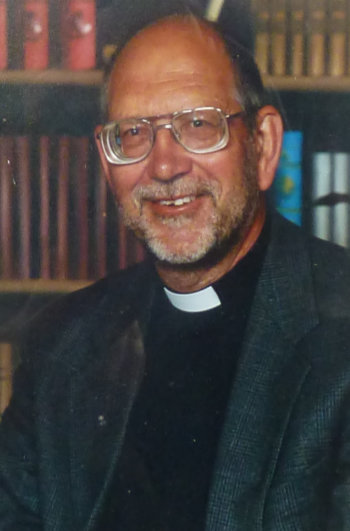
Fr. Underwood.
There was further reflection in 1996 when Fr David Underwood, who had replaced Simon Pettitt two years before, asked the PCC to consider the purpose of the worship at St John’s. ‘Worship is about going out and bringing in, not just a retreat for ourselves’, Underwood told his flock. It was decided to try some changes: the main service of the week, the 10.00 a.m., would start half an hour earlier, and a new non-sacramental family service with modern music would follow. Due to lack of support the 8.00 a.m. would be dropped. The evening service would be varied, with Taizé-type worship and healing services alternating with evensong. As a way of reaching out to the neighbourhood, and deepening the faith of the congregation, Fr Underwood considered exploring the Alpha Course, an evangelistic programme created by Holy Trinity Brompton Church in London. This did not materialize.
Facing the issue of women priests
Since the mid-1960s the Church had not had a full-time assistant curate or deacon to support the Vicar, but in July 1992 a deacon, Anne Haselhurst, was appointed. In the November the Church of England voted in favour of the ordination of women to the priesthood, and when it became known that Mrs Haselhurst was preparing for ordination, the Church had to decide whether it could accept a woman priest. There had been some initial hesitation about this among church members, but many members changed their minds during Mrs Haselhurst’s time as deacon, and when the PCC met with the Archdeacon to say whether they would accept a woman’s priestly ministry, the vote was unanimously in favour. This was by no means a common position among Anglo Catholic churches.
In February 1993 Fr Pettitt left St John’s to become diocesan communications officer. The diocese was in no hurry to replace him, and in the months before Mrs Haselhurst’s ordination to the priesthood in April 1994, services were taken by retired priests. Mrs Haselhurst, however, while still in training, performed most of the other duties, including leading midweek services with reserved sacrament. In the months before Fr Underwood’s appointment late in 1994 she was a priest in the Church
Into the new millennium
In 1998 Fr Underwood became Vicar of St George’s in addition to St John’s. Later the two parishes were joined with All Saints in a team ministry, with Greg Webb as the first Rector. All three churches are now in the Lark Valley and North Bury Team Ministry, covering a total of ten parishes.
The Lathbury Institute was sold in 2000 and converted into a 3-bedroom house and a small courtyard of dwellings. These are known as Lathbury Court. The trustees of the Lathbury Institute and the St John’s Centre now work together, and, following a report in 1999 by Peter Harris, Youth and Community Worker for St John’s and St George’s, entitled A Place for All – which said the centre was under-used and under-developed – it began to be hired for a wide variety of activities. Since 1998 it has hosted ‘Just Traid’, Bury’s only dedicated fair trade shop and café. A major restoration and development project took place at the end of the first decade of the new millennium.
In 2006, following a national competition, the Church commissioned a set of Stations of the Cross from the celebrated religious artist Iain McKillop. These were dedicated by the Bishop of Dunwich, the Rt Revd Clive Young, on 2 February 2008. In addition to the traditional fourteen stations McKillop designed as a fifteenth station an altarpiece of the resurrection which is displayed in the Lady Chapel.