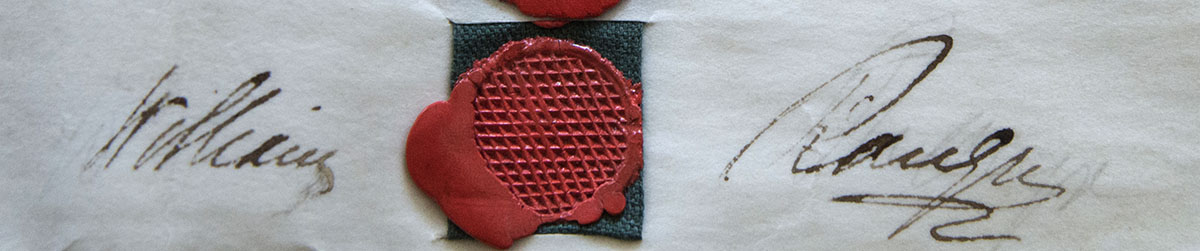
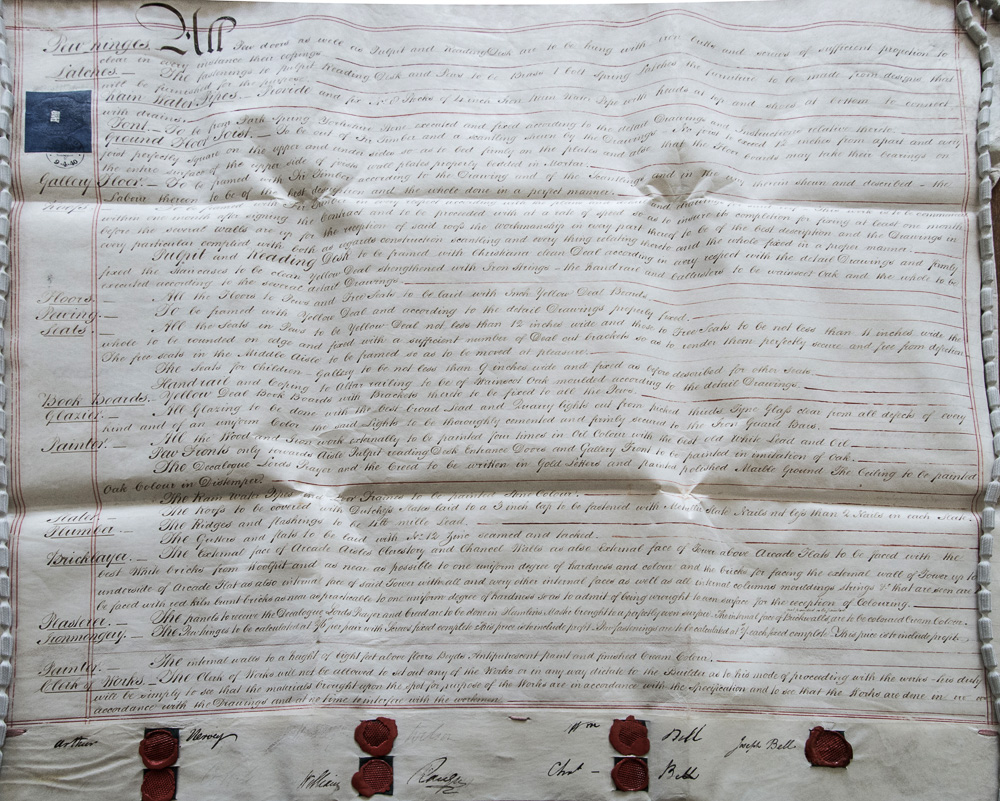
William Ranger (1799-1863) was born at Ringmer in East Sussex, the son of a builder called Richard Ranger (1774/75-1839). Richard moved the family to Brighton, and by the 1820s father and son were working together.
Within a year, still in his early 20s, William Ranger was appointed as the main contractor for the building of the Church of St Peter in Victoria Gardens, Brighton, designed by Sir Charles Barry, perhaps the most important architect at that time. In 1825 he received the contract to build the Sussex County Hospital in Brighton when Barry was appointed its architect, and shortly after the contract for building the Esplanade, landscaping the beach and building a tunnel under the Marine Parade. Ranger worked for Barry again in 1827 in carrying out repairs and improvements at Petworth church.
In the 1830s, Ranger moved to London in order to sell a new type of artificial stone he had invented, which Barry himself used on some occasions – an important material for 19th-century architects. Ranger’s first work as an architect seems to have been in 1827 for St James, Lancing, and he produced a design for a new aisle at Southwick church in 1833, which was not carried out.
His most important works as an architect are, however, all in Suffolk. Ranger’s first commission in the county was to build a family chapel, pew and vault for the Herveys in Ickworth church in the early 1830s. The link to the Herveys came, no doubt, from Brighton, where they owned Kemp Town. Ranger’s first wholly new building, however, was St Mary, Westley, a couple of miles west of Bury St Edmunds, and built in 1835-36. Like St John’s, it was funded by public subscription on land given by Frederick Hervey, 1st Marquess of Bristol.
Ranger used a highly innovative system of precast concrete blocks to build the tower and walls of St Mary’s, and cast iron for the roof. Like St John’s it is in the style of the 13th century and once had a rather flamboyant tower with pinnacles and flying buttresses – which would appear again at St John’s. Otherwise, however, the two churches are quite different: Westley has an off-centre tower, more modest exterior ornamentation and stepped lancet lights. Nevertheless, the Marquess of Bristol must have been sufficiently impressed to hire Ranger again. Indeed, St John’s was a far more ambitious project with aisles and a vast west tower, but it also seems to have been Ranger’s last major work as an architect.
Ranger would become a highly successful civil engineer, most notably for the Great Western Railway, with whom he later had a long and acrimonious lawsuit. In 1848 he became a Superintending Inspector of the General Board of Health, reporting on local sanitation and drainage projects, which he did for the rest of his life. He died, three years after his wife, Sarah, at his home in Pimlico, London, on 12 September 1863.